
Table of Contents
- How to Plan a Small Backyard Renovation That Works
- 1. Add a Backyard Fire Feature for Year-Round Use
- 2. Design a Small Outdoor Kitchen Layout That Fits
- 3. Install Durable Outdoor Wall Cladding for Privacy and Style
- 4. Use Vertical Gardens and Container Planting to Maximize Space
- 5. Layer Outdoor Lighting and Shade Structures
- 6. Plan Drainage, Permitting, and HOA Compliance Early
- 7. Choose Low-Maintenance Materials and Smart Technology
- Quick Reference: Matching the Idea to Your Constraint
- Where to Start
- Frequently Asked Questions
Last Updated: September 29, 2026
How to Plan a Small Backyard Renovation That Works
A small backyard renovation succeeds or fails on two decisions made before anyone picks a paver or a plant: how the space is measured and how the budget is set. At Bellafina Outdoors, our design team sees the same pattern in Huntington Beach and across coastal Orange County, where lots are tight and outdoor space has to work harder than it does almost anywhere else in the region. Get the measurements and the money right, and every idea below becomes easier to execute. Skip them, and even a well-chosen fire bowl ends up in the wrong corner.
Below, we break down the ten ideas that hold up best for 2026, plus the planning steps that keep a small outdoor living space from turning into a collection of disconnected purchases.
Measure First, Design Second
Start with a scale drawing on graph paper or in a design app, marking the house wall, fence lines, utility boxes, hose bibs, and gas stubs. Note door swings and traffic paths, because a path that pinches below about three feet starts to feel like an obstacle course.
Spatial planning is the step most homeowners skip, and it's the one that determines whether a fire feature, seating, and a grill can coexist without crowding.
If you want to see how a layout actually reads before committing, Bellafina Outdoors offers design and visualization services that turn measurements into realistic renderings, so you can catch a bad sightline before it's built.
Set a Realistic Budget and Timeline
Split your budget into hardscape, softscape, products, and a contingency line. Renovations almost always surface something unexpected, whether it's a drainage issue or a gas line that needs rerouting, and a contingency keeps the project from stalling halfway through.
Timelines stretch when permits or HOA approvals are involved, so build in buffer weeks rather than assuming approval is instant. Ordering long-lead products early also prevents the awkward gap where the yard is torn up but the fire feature hasn't arrived.
1. Add a Backyard Fire Feature for Year-Round Use
A fire feature extends evening use into the cooler months, and it does more for a small yard than almost any other single addition. In a compact space, it becomes the anchor that seating, lighting, and planting arrange themselves around.
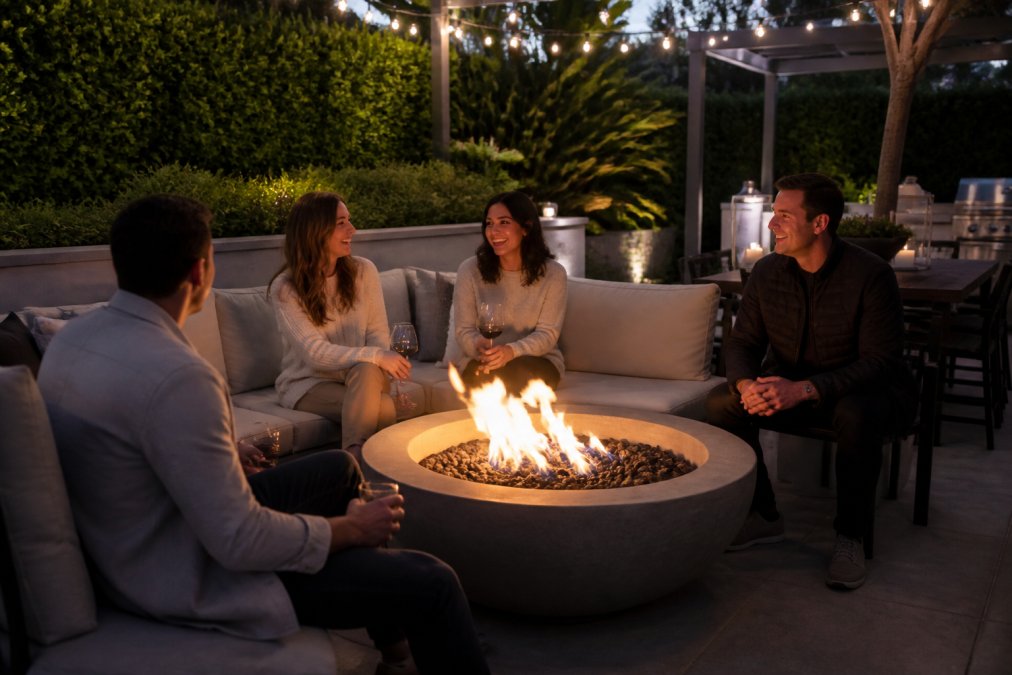
For tight footprints, a fire bowl beats a full fire pit because it delivers the same focal point in less square footage. The Square Maya Fire Bowl is a strong starting point: glass-fiber reinforced concrete, a stainless steel burner, seven color options, and a choice of match-lit or electronic ignition, compatible with natural gas or propane. The Cazo Fire Bowl offers the same construction in four colors for a slightly different silhouette. If you prefer a low, linear profile that doubles as a surface, the Balboa Fire Table comes in eighteen color options and works well as a coffee-table-height centerpiece.
A common mistake is sizing the fire feature to the yard's width rather than to the seating group. A bowl that's too large leaves no room to walk around it, and clearance matters more than diameter.
2. Design a Small Outdoor Kitchen Layout That Fits
A workable small outdoor kitchen layout follows one rule: keep the cook zone on a single wall or an L, not scattered across the yard. A grill, a landing surface on each side, and a small under-counter refrigerator cover most cooking needs without eating the patio.
Think in stations. Prep, cook, serve. When those three zones sit within a step or two of each other, a compact kitchen feels efficient instead of cramped. When they're spread out, even a large patio feels annoying to cook in.
For homeowners worried that premium appliances will overwhelm a smaller yard, the opposite is usually true. A well-proportioned grill and a clean counter run read as intentional in a small space, while a scattered collection of mismatched pieces reads as clutter. Bellafina Outdoors carries outdoor kitchens and grills in the Huntington Beach showroom, so you can compare footprint and finish in person before specifying anything.
3. Install Durable Outdoor Wall Cladding for Privacy and Style
Durable outdoor wall cladding solves two small-yard problems at once: it blocks sightlines from neighbors and it turns a blank fence or wall into a design feature. Materials matter here, because coastal conditions punish anything that can't handle salt air, moisture, and sun.
When selecting cladding, weigh these factors:
- Weather resistance: how the material handles moisture, UV, and salt exposure over time
- Maintenance: how often it needs cleaning, sealing, or refinishing
- Weight: whether your wall or fence structure can carry it
- Compatibility: how it pairs with your hardscape and architectural finishes
- Budget: cost per square foot plus installation complexity
A cladding that looks right but needs refinishing every year is a poor trade in a coastal climate. Ask about finish and care requirements before you commit, and confirm the material suits a vertical application rather than assuming a flooring product will work on a wall.
4. Use Vertical Gardens and Container Planting to Maximize Space
Vertical gardens and container planting let you grow far more greenery than your ground footprint allows. A wall of planters, a trellis, or a stacked system turns a fence into a living surface, and containers let you move color around as the seasons change.
Container gardening is especially useful in small yards because it sidesteps poor or compacted soil and gives you full control over drainage. Group pots by water need so irrigation stays simple.
Drought-tolerant and native plants belong on your shortlist for a Southern California yard. They ask less of your irrigation system and tend to hold up better through dry stretches. Perennials return year after year, which means less replanting and a garden that fills in over time. Hanging baskets and a terrace garden arrangement can add height without consuming floor space.
5. Layer Outdoor Lighting and Shade Structures
Outdoor lighting and shade structures work as a pair: one controls how the space feels after dark, the other controls whether it's usable at midday. In a small yard, both need to be layered rather than delivered by a single fixture or a single overhead structure.
Light in three tiers. Ambient light for overall visibility, task light near the grill and prep areas, and accent light to graze a wall or uplight a tree. Layering keeps a small space from feeling either flat or glaring.
For shade, a pergola, a cantilevered umbrella, or a retractable awning each suit different footprints. A cantilever umbrella frees up floor space because the base sits to one side.
6. Plan Drainage, Permitting, and HOA Compliance Early
Drainage, permitting, and HOA compliance are the least glamorous part of a small backyard renovation and the most expensive to get wrong. Address them at the design stage, not after materials are ordered.
7. Choose Low-Maintenance Materials and Smart Technology
Low-maintenance materials and smart technology reduce the ongoing work a small yard demands, which matters most for homeowners who want to enjoy the space rather than maintain it.
Quick Reference: Matching the Idea to Your Constraint
| If your constraint is... | Prioritize this idea | Why it helps |
|---|---|---|
| Very limited square footage | Vertical gardens and containers | Grows greenery upward, not outward |
| Neighbor sightlines | Durable outdoor wall cladding | Adds privacy and a finished surface |
| Year-round use | Backyard fire feature | Extends evening use into cooler months |
| Cooking outdoors | Small outdoor kitchen layout | Keeps prep, cook, and serve within a step |
| Harsh midday sun | Layered lighting and shade | Makes the space usable all day |
| Low upkeep preference | Low-maintenance materials and smart tech | Cuts recurring maintenance work |
| Water pooling or runoff | Drainage planning | Protects the house and hardscape |
Where to Start
The ideas above work together, not in isolation. Sequence the planning first, then the products.
Frequently Asked Questions
What backyard trends are predicted for 2026?
Small backyard renovation in 2026 leans toward multi-functional layouts, smart irrigation and lighting controls, and climate-specific planting. Homeowners are choosing durable materials like fiber-reinforced concrete and Corten steel for fire features, plus vertical gardens and container planting to add greenery without floor space. Permitting and HOA compliance are also shaping designs earlier in the planning process.
How can I make a small backyard look bigger?
Use vertical elements like wall cladding, hanging baskets, and vertical gardens to draw the eye upward. Choose multi-functional furniture and consistent patio pavers that flow from the house to the yard edge. A single focal point, such as a fire bowl or water feature, reduces visual clutter and makes the space feel intentional rather than cramped.
What are the best low-maintenance backyard renovation ideas?
Drought-tolerant native plants, container gardening with perennials, and durable hardscaping like concrete or stone pavers cut upkeep. Smart irrigation and low-voltage outdoor lighting reduce daily tasks. A glass-fiber reinforced concrete fire pit or Corten steel feature weathers well with minimal care, and robotic pool cleaners can handle pool maintenance if your yard includes water.
How do I choose durable materials for a small outdoor space?
Match materials to your climate and use. In coastal Southern California, salt air and sun exposure favor fiber-reinforced concrete, Corten steel, and UV-stable finishes. For wall cladding, look for moisture- and fade-resistant options. Confirm warranty and care requirements with the manufacturer before you buy, and ask your designer how each material performs over time.