
Table of Contents
- Why Modern Luxury Fire Pits Define Today's Outdoor Living Space
- Quick Comparison: Fire Pit Styles and Best Uses
- 1. Fire Tables: Integrated Centerpieces for Patio Design
- 2. Fire and Water Bowls: Sculptural Focal Points
- 3. Wood Grain Concrete Fire Pits for a Natural Modern Aesthetic
- 4. Hammered Copper and Stainless Steel Statement Pits
- 5. Small Backyard Fire Pit Solutions That Still Feel Luxurious
- 6. Gas vs. Wood-Burning: Choosing Your Fuel Source
- What Most Guides Leave Out: Maintenance, Climate, and Control
- Where to See These Options in Person
- Frequently Asked Questions
Last Updated: September 19, 2026
Why Modern Luxury Fire Pits Define Today's Outdoor Living Space
A luxury fire pit is no longer an accessory you drop onto a finished patio. It anchors the entire outdoor living space, deciding where people sit, how long they stay, and whether the yard gets used in January or only in July. At Bellafina Outdoors, we see this constantly with Orange County homeowners, designers, and pool builders: the fire feature gets chosen last, and everything else has to work around it.

That is backwards. The best 10 modern luxury fire pit design ideas for backyards all share one trait: the fire feature was planned alongside the hardscape, seating, and lighting, not after.
A fire pit is a permanent architectural element combining a burner, surround material, fuel connection, and defined safety clearance. Get one wrong and the whole composition suffers.
Three shifts drive the change: fire tables and bowls now double as sculpture, carrying visual weight even unlit; gas and electronic ignition have made flames push-button; and designers treat the fire element as the organizing line for seating walls, pavers, and ambient lighting.
Below, we break down ten directions worth considering, plus a comparison of styles, fuel sources, and the small-yard question we hear weekly.
Quick Comparison: Fire Pit Styles and Best Uses
The fastest way to narrow ten options down to two is to match the style to the space you actually have. Here is how the main categories stack up.
| Style | Best For | Fuel Options | Footprint |
|---|---|---|---|
| Fire table | Integrated patio centerpiece | Natural gas, propane | Medium to large |
| Fire and water bowl | Sculptural focal point | Natural gas, propane | Medium |
| Wood grain concrete | Natural modern aesthetic | Natural gas, propane | Medium to large |
| Hammered copper or stainless | Statement piece, coastal exposure | Natural gas, propane | Medium to large |
| Compact bowl | Small patios, balconies | Propane, natural gas | Small |
| Outdoor fireplace | Vertical drama, wind protection | Wood or gas | Large |
One pattern holds: the more integrated the feature, the more planning it needs up front. A freestanding bowl can arrive late; a fire table built into a seating wall cannot.

1. Fire Tables: Integrated Centerpieces for Patio Design
A fire table is a linear or rectangular fire feature built at seating height, functioning as table surface, heat source, and visual center at once. That triple duty makes it the default choice for new builds in coastal Orange County.
The design logic is simple: instead of a round pit ringed by chairs, you build the fire into the architecture. A seating wall runs along one side, the fire table sits flush with the patio, and the conversation area forms around a single line.
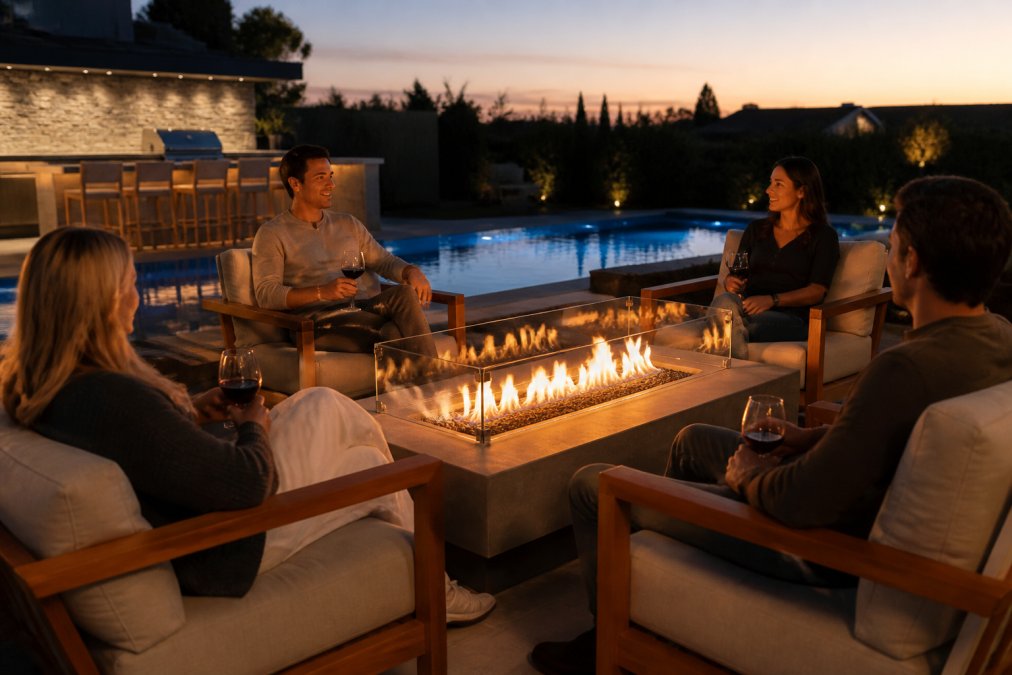
Material choice matters most here, since the surround is visible from every seat. Glass-fiber reinforced concrete holds a crisp edge and handles coastal moisture. Powder-coated steel gives a lower, more industrial profile. Hammered copper develops a patina that either delights or bothers you, no middle ground.
What most guides miss is the burner placement. A long linear burner produces a thin, even flame line; a shorter burner in a long table leaves dead zones at the ends. If the table is the centerpiece, the flame should run its full length.
2. Fire and Water Bowls: Sculptural Focal Points
Combining fire and water in one vessel sounds like a gimmick until you sit beside one. The contrast between moving water and open flame reads as sculpture from across the yard, and the water sound masks traffic noise in denser neighborhoods.
The Luna Fire and Water Bowl is a good example of the category. It comes in nine color options, is made from glass-fiber reinforced concrete with a stainless steel burner, and offers either match-lit or electronic ignition. Lava rock is included, and the burner is compatible with both natural gas and propane. It is made in the United States.
This style earns its keep at the end of a sightline, place it where a guest looks stepping out the back door and it does the work of art. Place it in a traffic path and it becomes an obstacle.
The honest limitation: fire and water features need a water line and a drain consideration, so they belong early in the planning conversation, not after the hardscape is set.
3. Wood Grain Concrete Fire Pits for a Natural Modern Aesthetic
Wood grain concrete fire pits give you the warmth of timber with the durability of cast concrete, the trade-off many Southern California yards need. Real wood means maintenance, rot, and termite risk; molded wood grain concrete means none of that.
The Big Sur Fire Pit is a strong representation of this direction.
4. Hammered Copper and Stainless Steel Statement Pits
Metal fire pits are for those who want the fire feature to be the boldest object in the yard. Hammered copper brings a warm, hand-worked surface that changes over time; stainless steel brings a cooler, architectural read that holds up in salt air.
5. Small Backyard Fire Pit Solutions That Still Feel Luxurious
Small yards are not a barrier to a luxury fire feature, they are a design constraint, and constraints produce better decisions. An 800-square-foot patio can hold a fire feature that feels intentional rather than squeezed in, if you pick the right format.
Three approaches work consistently:
- Compact round or square bowls in the 30" to 36" range, which fit a four-chair arrangement without crowding
- Narrow linear tables that run along a wall or seat wall instead of occupying open floor
- Fire features that double as furniture, such as a low table with a center burner, so the footprint earns its space twice
6. Gas vs. Wood-Burning: Choosing Your Fuel Source
Gas wins for most residential projects, and it is not close. Natural gas gives a permanent connection with no refilling; propane gives placement flexibility where a gas line is impractical. Both deliver instant, controllable flames with no ash, sparks, or firewood storage.
| Factor | Natural Gas | Propane | Wood |
|---|---|---|---|
| Startup effort | Push button | Push button | 15-30 minutes |
| Cleanup | None | None | Ash removal |
| Placement flexibility | Fixed to gas line | Anywhere with tank access | Anywhere with ventilation |
| Ambiance | Clean, even flame | Clean, even flame | Crackle and smoke |
| Ongoing cost | Utility bill | Tank refills | Firewood |
What Most Guides Leave Out: Maintenance, Climate, and Control
Three factors separate a fire feature that looks good on day one from one that still works in year five. Most design roundups skip all three.
Where to See These Options in Person
Photographs flatten fire features. Scale, finish, and flame height are things you read with your eyes in a real space, and a rendering only takes you so far.
Frequently Asked Questions
What is the current trend in luxury fire pits for backyards?
The biggest shift is toward integrated fire tables and sculptural fire-and-water bowls that double as centerpieces, plus smart ignition systems and weather-resistant finishes. Homeowners in coastal areas are also choosing glass-fiber reinforced concrete and stainless steel burners that hold up to salt air. Many modern luxury fire pit designs now pair natural gas or propane with fire glass or lava rock for a clean, contemporary look that fits a minimalist or architectural style.
What safety considerations are required for custom backyard fire pit installation?
Clearance requirements depend on your local code, but a common rule is keeping combustible materials at least 10 feet from the flame and maintaining proper distance from structures, overhead branches, and property lines. Gas lines must be sized and installed by a licensed professional, and electronic ignition systems need a dedicated power source. Always confirm permit requirements with your local building department before breaking ground.
How do I choose the right fire pit material for a coastal climate?
For coastal Orange County yards, prioritize glass-fiber reinforced concrete, stainless steel, and powder-coated finishes that resist moisture and salt. Hammered copper develops a natural patina over time, which some homeowners love and others prefer to seal. Avoid untreated mild steel, which rusts quickly near the ocean. Weather-resistant materials cost more upfront but hold their appearance far longer in salt air.
Can a luxury fire pit increase my property value?
A well-designed fire feature can add perceived value by extending usable outdoor living space and creating a backyard sanctuary buyers remember. Appraisal impact varies by market and how the feature integrates with the overall patio design, landscaping, and hardscape. The strongest returns come when the fire pit feels intentional, matches the home's architectural style, and pairs with seating, lighting, and durable materials rather than standing alone.
What is the difference between a fire table and a traditional fire pit?
A fire table has a flat, wide surface around the burner, so it works as both a heat source and a gathering table for drinks or small plates. A traditional fire pit is typically rounder and deeper, built mainly for ambiance and warmth. Fire tables suit modern, minimalist patios and integrate easily with outdoor furniture, while traditional pits often anchor a seating wall or flagstone layout.