
Table of Contents
- Why Material Selection Matters for Outdoor Kitchens
- Stainless Steel: The Industry Standard
- Outdoor Kitchen Countertop Durability
- Weather-Resistant Outdoor Cabinetry
- Modular vs. Custom Outdoor Kitchens
- Natural Stone and Masonry Finishes
- Material Hierarchy and Climate Compatibility
- Conclusion
- Frequently Asked Questions
Last Updated: August 31, 2026
Why Material Selection Matters for Outdoor Kitchens
Choosing the right materials for an outdoor kitchen determines whether your investment survives coastal salt air, intense UV exposure, temperature swings, and constant use. What works beautifully in a showroom can fail spectacularly when exposed to the elements for months or years. At Bellafina Outdoors, we provide expert guidance to homeowners and contractors through this decision. The difference between a kitchen that looks stunning for five years and one that performs flawlessly after a decade often comes down to material choices made before construction begins.
This guide breaks down the outdoor kitchen materials that actually deliver in 2026, what works, what fails, and why the material combinations you choose today will determine whether you're enjoying your space or fighting maintenance battles five years from now.
Stainless Steel: The Industry Standard
Stainless steel dominates outdoor kitchens because it's the only metal that genuinely resists corrosion in salt-air and humid environments without requiring constant maintenance. When properly specified, it delivers both performance and the professional aesthetic most homeowners want.
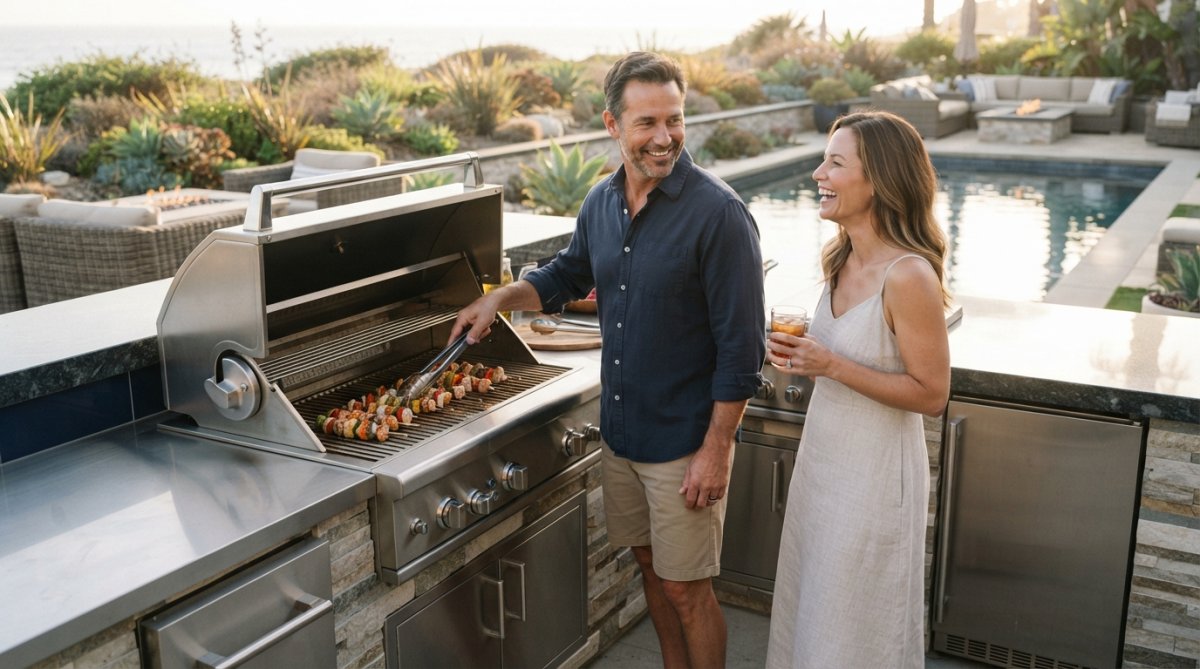
The catch? Not all stainless steel is equal. The grade you choose determines whether you're getting five years or fifteen years of reliable performance.
AISI 304 vs. 316 Grades
AISI 304 stainless steel is the standard choice for most outdoor kitchens. It contains chromium and nickel, which create a protective oxide layer that resists corrosion. For inland and moderate climates, 304 performs well and is widely available and cost-effective.
AISI 316 stainless steel adds molybdenum to the alloy, creating superior corrosion resistance in salt-air and high-humidity environments. If your kitchen sits within five miles of the coast or in an area with consistent moisture exposure, 316 justifies its higher cost. The molybdenum specifically resists chloride pitting, the corrosion that salt air causes.
A 304 grill in coastal Orange County might show surface pitting and discoloration within three to four years. A 316 grill in the same location stays pristine for a decade. For contractors and homeowners in Southern California's coastal zones, 316 is the specification that prevents callbacks and warranty disputes.
Outdoor Kitchen Countertop Durability
Countertops take the most abuse in an outdoor kitchen: direct sun, temperature swings, spilled liquids, grease splatter, and constant food prep. The material you choose here shapes both the kitchen's lifespan and your maintenance burden.
Granite and Quartzite Performance
Granite is porous, which means it absorbs liquids, oils, and stains unless sealed. In an outdoor kitchen where spills happen constantly and UV exposure degrades sealers over time, granite requires resealing every 12-18 months. It's beautiful and heat-resistant, but the maintenance commitment is real.
Quartzite is denser and less porous than granite, making it more stain-resistant and requiring less frequent sealing, typically every 2-3 years in outdoor settings. It's also harder and more scratch-resistant. For outdoor applications where durability matters, quartzite outperforms granite in almost every measurable way.
Both are natural stone subject to thermal expansion. Wide temperature swings between morning and evening can cause micro-cracking over time, especially if the stone is dark and absorbs heat aggressively. Lighter colors and properly installed expansion joints mitigate this risk.
The leathered finish, a textured surface treatment, is trending in 2026 because it hides water spots and mineral deposits better than polished finishes, reducing the visual maintenance burden. Bellafina Outdoors carries leathered marble and quartzite options like the 12 X 24 X 1 1/4" Crema Marble Leathered Finish Paver and 12 X 24 X 1 1/4" Cool Grey Marble Leathered Finish Paver, which perform well in coastal climates while maintaining that sophisticated aesthetic.
Concrete and Porcelain Slabs
Polished concrete offers a modern aesthetic and excellent thermal mass, staying cooler under intense sun than stone. It's customizable in color and finish but is porous and stains easily. Spilled wine, oil, or rust-prone items leave permanent marks unless sealed immediately. Sealing concrete countertops annually is necessary in outdoor kitchens.
Porcelain slabs have emerged as the durability winner for outdoor countertops in 2026. They're non-porous, virtually stain-proof, and require zero sealing. Porcelain resists UV fading, thermal shock, and freeze-thaw cycles better than natural stone. The downside is that porcelain can chip if struck hard, and installation requires precision.
For homeowners who want a countertop that requires minimal maintenance and performs reliably in harsh climates, porcelain is the material that delivers.
Weather-Resistant Outdoor Cabinetry
Cabinetry is where most outdoor kitchens fail. Traditional wood cabinets rot. Standard plywood swells and delaminates. Metal frames rust. The cabinet material you specify determines whether the kitchen looks fresh in year three or shows visible deterioration.
Marine-Grade HDPE and Polymer Options
Marine-grade HDPE (high-density polyethylene) is the material that changed outdoor cabinetry. It doesn't rot, doesn't absorb moisture, and resists UV degradation. HDPE cabinets can sit in coastal salt air for years without structural failure. They're lightweight, affordable, and require only occasional cleaning.
The limitation: HDPE can feel plastic-y compared to natural materials and has lower heat tolerance than wood or metal. Place a hot pan directly on an HDPE surface and it can scorch or warp. But as a cabinet box material in a well-designed kitchen where countertops and backsplashes handle heat exposure, HDPE is bulletproof.
Composite polymer blends take HDPE further by adding wood fiber or other materials to improve the aesthetic while maintaining moisture resistance. These materials look more like traditional cabinetry but retain the durability advantages of pure polymers.
For contractors building kitchens in Orange County's humid coastal environment, marine-grade HDPE eliminates the callback risk that comes with wood or standard plywood.
Powder-Coated Galvanized Steel Frames
Powder-coated galvanized steel provides structural support and a sleek industrial aesthetic. The galvanizing process creates a zinc coating that resists rust, and the powder coat adds color and additional protection. Steel frames paired with HDPE or composite panels create a hybrid system that's both durable and visually sophisticated.
Confirm the steel is galvanized before powder coating. Steel without galvanizing will rust through the powder coat within a few years in coastal environments. Galvanized-then-powder-coated steel can last indefinitely with minimal maintenance.
Steel frames also handle thermal expansion better than plastic. When the sun heats a black cabinet to 140°F and then evening cools it to 60°F, steel flexes without cracking.
Request a Design Consultation →
Modular vs. Custom Outdoor Kitchens
The material durability story changes when you compare modular systems to fully custom builds.
Modular outdoor kitchens use prefabricated cabinet boxes, grills, and components that bolt together on-site. Manufacturers control material quality and testing. Most modular systems use marine-grade HDPE or composite cabinets paired with 304 or 316 stainless steel appliances. The advantage is consistency and predictability; the disadvantage is limited customization.
Custom outdoor kitchens allow unlimited material combinations. You can specify 316 stainless steel frames, quartzite countertops, and integrated stone accents. The downside is coordination complexity. If materials aren't specified correctly or installed with proper expansion joints, performance suffers.
For homeowners who want design flexibility and are willing to manage coordination, custom builds allow material choices that modular systems can't match. For those who want turnkey reliability, modular systems take the guesswork out of material compatibility.
The best approach combines elements of both: specify proven modular components for the grill and major appliances, but customize the cabinetry, countertops, and finishes to match the home's aesthetic and performance requirements. Working with a design partner who understands outdoor living design and visualization helps you see how these material combinations will look and perform before construction begins.
Natural Stone and Masonry Finishes
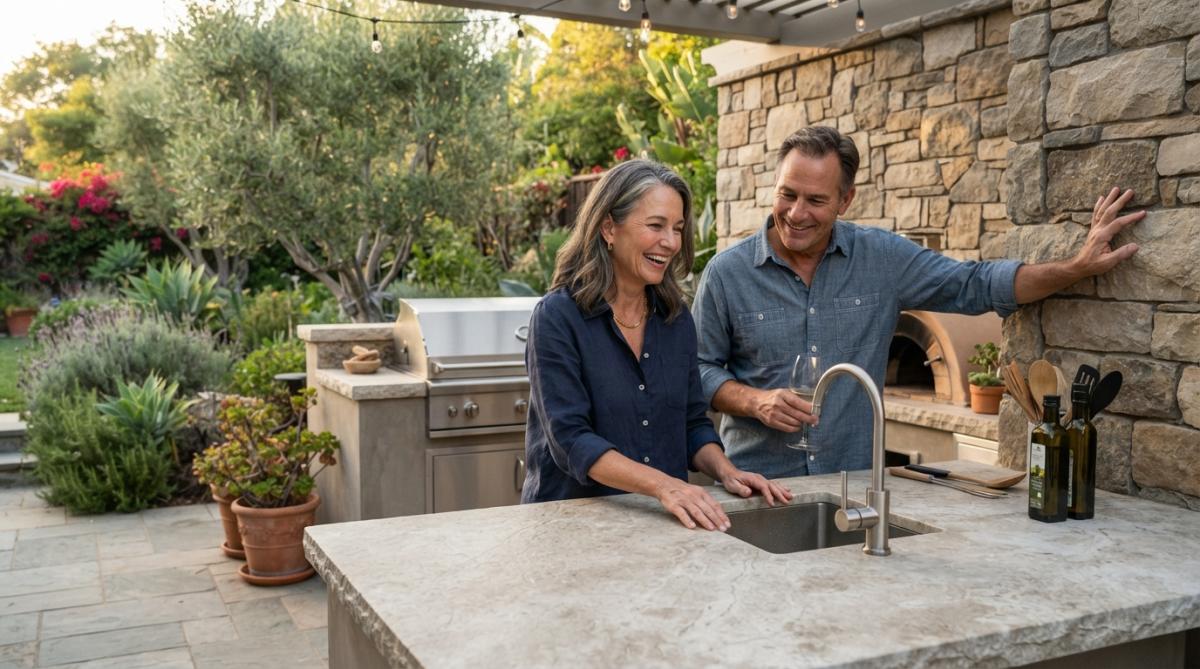
Natural stone isn't just for countertops. Stone accents, backsplashes, and structural elements define the visual character of a high-end outdoor kitchen.
Travertine, Marble, and Slate
Travertine is a sedimentary stone with natural pitting and a warm, earthy aesthetic. It's softer than granite or quartzite, which means it scratches more easily and requires more frequent sealing. In outdoor kitchens, travertine works beautifully for accent walls or backsplashes where it won't take direct abuse. The tumbled finish hides water spots and mineral deposits naturally.
Bellafina Outdoors carries 12 X 24 X 1 1/4" Ivory Travertine Tumbled Finish Paver and 12 X 24 X 1 1/4" Silver Travertine Tumbled Finish Paver, which provide authentic Mediterranean character while maintaining durability in coastal climates.
Marble is even softer than travertine and susceptible to etching from acidic liquids. In an outdoor kitchen where spills are inevitable, marble is primarily a design accent, not a work surface. Use it for visual impact on feature walls or as decorative cladding.
Slate is dense and naturally slip-resistant, making it ideal for outdoor flooring and step treads around the kitchen. It's more durable than travertine or marble but still requires sealing in high-moisture environments. The natural texture and color variation make slate visually interesting.
Use quartzite or granite for countertops where durability is essential, travertine or slate for accent walls and flooring where aesthetics matter more than abuse resistance, and marble sparingly as a design accent where it won't see heavy use.
Material Hierarchy and Climate Compatibility
Not all outdoor kitchen materials perform equally in every climate. Coastal environments, desert heat, and humid inland climates each demand different material strategies.
Coastal climates (like Southern California) prioritize corrosion resistance and UV stability. Specify 316 stainless steel over 304. Choose marine-grade HDPE or composite cabinetry. Use quartzite or porcelain countertops rather than porous granite. Salt air is unforgiving, and material choices that seem premium elsewhere become mandatory here.
Desert climates emphasize thermal management and UV protection. Dark materials absorb heat aggressively, causing expansion and contraction stress. Light-colored stone and reflective finishes reduce thermal shock. HDPE and composite cabinetry hold up well because they don't absorb moisture, but thermal cycling can warp them if not properly supported.
Humid inland climates require moisture barriers and fungal resistance. Sealing becomes critical because humidity promotes mold growth on porous materials. Galvanized steel and composite cabinetry outperform wood-based systems. Porcelain and sealed quartzite resist moisture-related staining better than porous stone.
Conclusion
The best outdoor kitchen materials in 2026 balance durability, aesthetics, and maintenance reality. AISI 316 stainless steel, marine-grade HDPE cabinetry, quartzite or porcelain countertops, and properly specified stone accents create kitchens that perform for a decade or more without constant upkeep.
The real mistake most homeowners make isn't choosing one material over another; it's failing to think through the material hierarchy as a system. A beautiful quartzite countertop paired with wood cabinets that rot in three years isn't a kitchen, it's an expensive maintenance problem. Conversely, a kitchen where every material is specified for durability but the design feels institutional isn't worth building.
At Bellafina Outdoors, our outdoor living design and visualization services help you see exactly how material choices will look and perform before construction begins. We carry premium stone, finishes, and architectural elements that work in coastal Southern California climates, and our team can walk you through the durability tradeoffs so you're making informed decisions. Whether you're planning a modular kitchen or a fully custom build, visiting our Huntington Beach design center lets you see material samples, texture options, and finish variations side by side. Request a design consultation to start planning your outdoor kitchen with materials that will actually last.
| Material | Best For | Climate Suitability | Maintenance Frequency | Durability Rating |
|---|---|---|---|---|
| AISI 316 Stainless Steel | Grills, appliances, frames | Coastal, high-humidity | Occasional cleaning | Excellent |
| AISI 304 Stainless Steel | Inland grills, appliances | Moderate, inland | Regular cleaning | Good |
| Marine-Grade HDPE | Cabinet boxes, panels | All climates | Minimal | Excellent |
| Quartzite | Countertops, work surfaces | All climates | Annual sealing | Excellent |
| Porcelain Slabs | Countertops, finishes | All climates | None required | Excellent |
| Granite | Countertops, accents | Moderate climates | 12-18 month sealing | Good |
| Travertine | Accent walls, backsplash | Moderate to coastal | Annual sealing | Good |
| Powder-Coated Galvanized Steel | Frames, structural support | All climates | Minimal | Excellent |
Frequently Asked Questions
Q: What are the best outdoor kitchen materials for coastal climates?
A: In coastal environments, AISI 316 stainless steel, marine-grade HDPE cabinetry, and non-porous countertops like quartzite or porcelain slabs perform best. These materials resist salt-air corrosion and moisture damage. Leathered natural stone finishes like marble add aesthetic appeal while maintaining durability. Avoid untreated wood and lower-grade stainless steel (304) in salt-air settings, as they corrode faster. At Bellafina Outdoors, we stock premium finishes designed for these challenging environments.
Q: How do I choose between modular and custom outdoor kitchens?
A: Modular outdoor kitchens offer flexibility, faster installation, and lower upfront costs, ideal for smaller spaces or renters. Custom builds provide tailored layouts, premium material integration, and seamless design cohesion with your landscape. Consider your timeline: modular systems deploy in weeks, while custom kitchens take months for design, material sourcing, and construction. For complex layouts or specific material combinations, custom designs typically outperform modular options. Our design team can visualize both approaches before you commit.
Q: What countertop materials are trending for outdoor kitchens in 2026?
A: Quartzite, porcelain slabs, and leathered natural stone dominate 2026 trends. Quartzite offers durability and low maintenance with organic textures. Porcelain provides heat dissipation and comes in large-format slabs for clean lines. Leathered finishes on marble and granite reduce slipping while adding sophistication. Polished concrete is gaining traction for modern aesthetics. All these materials balance performance with design, supporting the 2026 shift toward materials that are both functional and visually striking.
Q: Is stainless steel worth the cost for outdoor kitchens?
A: Yes, if you choose the right grade. AISI 316 stainless steel costs more than 304 but resists corrosion far longer, especially in humid or coastal areas. The material handles high heat, is non-porous, and requires minimal maintenance beyond occasional cleaning. Over 10+ years, the durability and low upkeep offset the initial investment. For budget-conscious builds, 304 works in dry climates, but 316 is the safer choice for long-term performance and structural integrity in challenging environments.
Q: How do weather-resistant outdoor cabinetry materials compare in durability?
A: Marine-grade HDPE polymers resist moisture, UV damage, and salt corrosion, making them ideal for coastal areas. Powder-coated galvanized steel provides excellent structural support and rust resistance. Teak and other treated hardwoods offer warmth but require regular maintenance. HDPE requires minimal upkeep and lasts 15+ years; galvanized steel performs similarly with occasional recoating. For zero-maintenance durability in harsh climates, HDPE edges ahead. For aesthetic versatility and warmth, treated wood works if you're willing to refinish periodically.
This article was written using GrandRanker