
Table of Contents
- Why Homeowners and Designers Look Beyond Standard Pavers
- Porcelain Paver Benefits for Modern Hardscape Design
- Natural Stone vs Concrete Pavers: Which Holds Up Better
- Modern Outdoor Living Design Ideas That Start With the Surface
- Comparing Paver Alternatives Side by Side
- How Coastal Southern California Climate Shapes Your Choice
- Conclusion
- Frequently Asked Questions
Last Updated: September 13, 2026
Why Homeowners and Designers Look Beyond Standard Pavers
Designers searching for the best Saratoga Pavers alternatives for design share one frustration: the surface gets chosen last, after the kitchen, fire feature, and lighting plan. That order is backwards, the paving sets the module, color temperature, and maintenance rhythm for everything on top of it.
At Bellafina Outdoors, we see this constantly in our Huntington Beach design center: clients arrive with a paver sample taped to a kitchen rendering, and the two never quite agree. Standard concrete pavers are built for uniformity and price, not the large-format, low-joint look modern coastal landscaping leans toward. When hardscape and architecture pull in different directions, no amount of furniture fixes it.
Below, we break down the best Saratoga Pavers alternatives for design, what each surface actually does well, and how to match a paver to a Southern California backyard instead of a showroom floor.
Porcelain Paver Benefits for Modern Hardscape Design
Porcelain pavers are dense, rectified tiles made at a consistent 2cm thickness, so they sit on gravel, sand, or a concrete base with tight, uniform joints. For design work, that consistency is the point.
The benefits that matter most on a project:
- Color and finish consistency from batch to batch, which matters when a client approves a rendering months before installation
- Low water absorption, so coastal moisture and pool splash zones do not stain or darken the surface
- Large-format modules like 24x24 that reduce visible joint lines and make a small patio read bigger
- Resistance to fading, which keeps a light-colored surface light over years of sun exposure
- Simple cleaning, typically soap, water, and a stiff brush rather than sealing cycles
What most guides miss is the sub-base conversation. Porcelain performs on a properly compacted base, and skipping compaction is where installers get called back. The tile is not the weak point. The base preparation is.
Quarstone 24x24 Pavers: A Porcelain Option to Know
The Quarstone 24x24 2cm Paver is the format we reach for when a client wants a clean, contemporary plane with minimal grout lines. At $3.42 per square foot, it lands well below natural stone while giving designers a consistent module to draw against. Set on a compacted aggregate base with tight joints, the patio reads as one continuous surface rather than a grid.
Natural Stone vs Concrete Pavers: Which Holds Up Better
Natural stone pavers are quarried materials cut to thickness; concrete pavers are manufactured from cement, aggregate, and pigment in a mold. That distinction drives variation, maintenance, and how the surface ages.
Here is the honest comparison, including how a third category, porcelain, fits in:
| Surface | Look | Maintenance | Climate Resistance | Best For |
|---|---|---|---|---|
| Concrete pavers | Uniform, repeatable | Sealing every few years | Good, can fade | Budget-driven patios, driveways |
| Natural stone | Unique, high variation | Periodic sealing, weed prevention in joints | Excellent, ages with character | Estate patios, residential entrance |
| Porcelain | Consistent, large-format | Soap and water | Excellent, low absorption | Modern designs, pool decks |
| Decomposed granite | Soft, organic | Raking, replenishing | Good, can migrate | Walkways, garden paths |
Natural stone wins on character and structural integrity under heavy load. Concrete wins on price predictability and easy single-unit replacement. Porcelain wins when the intent is a quiet, monolithic surface that lets the outdoor kitchen and fire feature carry the visual weight.
The trade-off nobody mentions: natural stone's variation is a feature in a design review and a headache in a change order. Order with a waste allowance, because the second delivery will not match the first.
Crema Marble Pavers in Multiple Formats
For clients who want natural stone without a busy palette, Crema Marble in a leathered finish is the middle path. The leathered finish adds grip for pool decks and sloped walkways, and the warm neutral tone sits comfortably against light stucco and darker architectural finishes.
Bellafina carries it in several modules so the pattern can be tuned to the space:
- 12 x 24 Crema Marble Leathered Finish Paver at $8.65 per square foot, a clean running bond
- 16 x 24 Crema Marble Leathered Finish Paver at $8.75 per square foot, for fewer joints across a wide patio
- French Versailles Pattern Crema Marble Paver at $8.65 per square foot, combining 8x8, 8x16, 16x16, and 16x24 pieces
- Roman Pattern Crema Marble Paver at $7.50 per square foot, built from 6x6, 6x12, and 12x12 units
Modern Outdoor Living Design Ideas That Start With the Surface
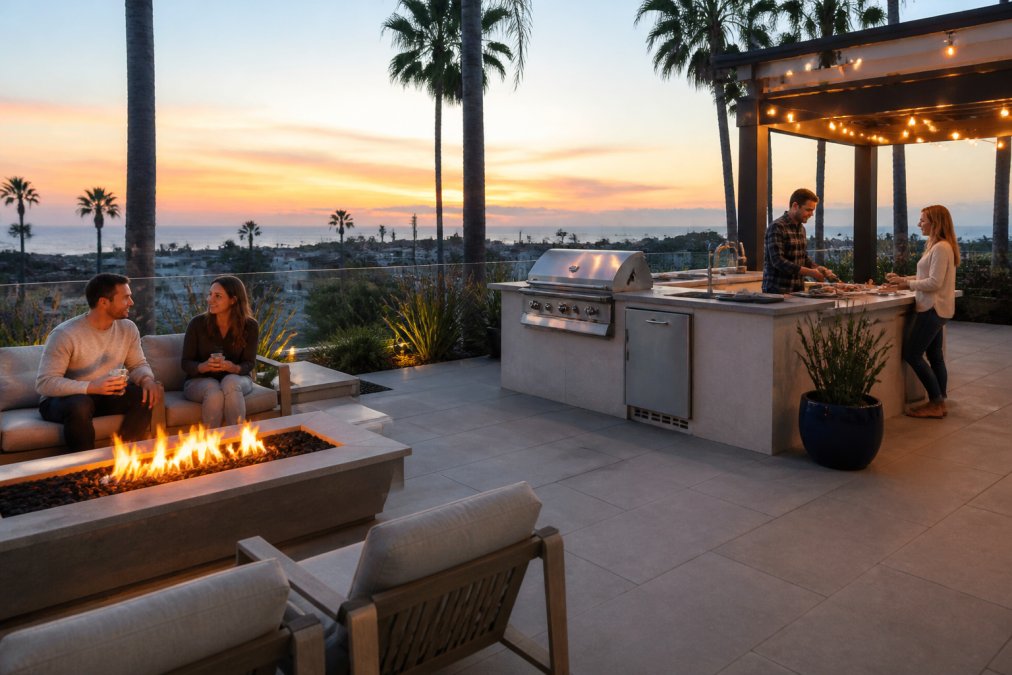
Modern outdoor living design begins with a restrained surface and layers texture above it. Pick one paving tone, then add contrast through the vertical elements: an outdoor kitchen island, fire feature, lighting, and planting.
A few combinations that work in coastal Southern California:
- Pale porcelain field with a darker fire feature surround. The surface stays quiet, the fire feature becomes the focal point after dark.
- Crema marble in a Versailles pattern with linear lighting. The pattern supplies movement; the lighting washes it without competing.
- Large-format pavers with a decomposed granite border. Softens the transition to planting and handles drainage at the edge.
The mistake is treating the patio as a standalone item. If your surface, kitchen counter, and fire feature surround all fight for attention, none wins. This is where a design and visualization session earns its keep, a rendering shows you the conflict before the base is excavated.
Comparing Paver Alternatives Side by Side
Choosing between these surfaces comes down to more than the sample tag. Three variables decide it: what the space is used for, how much upkeep the owner will actually do, and how the surface behaves over a decade rather than a season.
| Option | Price per Sq Ft | Format | Maintenance Load | Best For |
|---|---|---|---|---|
| Quarstone 24x24 Porcelain | $3.42 | 24x24, 2cm | Low | Modern patios, pool decks |
| Crema Marble Roman Pattern | $7.50 | 6x6, 6x12, 12x12 | Moderate | Traditional patios, walkways |
| Crema Marble 12x24 | $8.65 | 12x24, 3cm | Moderate | Running bond patios |
| Crema Marble Versailles | $8.65 | Multi-size | Moderate | Formal patios, residential entrance |
| Crema Marble 16x24 | $8.75 | 16x24, 3cm | Moderate | Wide patios, fewer joints |
The 10-Year Cost Picture Most Guides Skip
Upfront price per square foot is the easy number to compare. The harder one is what the surface costs to own:
- Porcelain carries a higher material cost than basic concrete but near-zero recurring cost beyond routine cleaning. No sealing cycle, no joint sand replenishment, no color refresh.
- Natural stone needs periodic sealing to hold up against salt air and pool splash. Sealing is a recurring line item, and porous stone that goes unsealed will stain and darken rather than fail outright.
- Concrete pavers sit between the two: lower material cost, but sealing every few years and the occasional unit replacement.
- Decomposed granite is inexpensive to install but needs raking and replenishing as it migrates, and it tracks indoors.
Run the math over ten years rather than one. A surface that needs sealing every few years carries a recurring cost that often closes much of the gap against a higher-priced material with no maintenance cycle. That calculation changes specifications, not the sticker price.
Request a Design Consultation →
DIY vs. Professional: Where the Labor Actually Goes
Most people searching for alternatives are trying to control cost, and labor is where the money hides:
- Low-labor surfaces, porcelain on a properly compacted aggregate base, or decomposed granite paths, are within reach of a capable homeowner for a small area. The work is excavation, compaction, and leveling, not tile setting.
- High-labor surfaces, multi-size natural stone patterns like Versailles or Roman, reward experience. The cutting, pattern alignment, and edge work are where a first-timer loses days and material.
- Anything over a structural base, pool decks, driveways, areas under heavy load, should be specified and installed by a professional. This is not a DIY category.
A practical rule: the more complex the pattern and the larger the area, the more DIY labor savings evaporate against rework. A simple running bond on a small patio can pencil out; a Versailles pattern across a full backyard usually does not.
This is the conversation we have most often at the Huntington Beach design center, not which paver looks best in a photo, but which one fits the budget, maintenance appetite, and site. Bring your project dimensions and we can compare options against real constraints.
How Coastal Southern California Climate Shapes Your Choice
Coastal Orange County asks more of a hardscape than most markets: salt air, marine layer moisture, intense summer sun, and occasional heavy rain all work on the same surface. But the variable that most often decides a project is not the climate, it is the ground underneath it.
Soil and Drainage: The Variable Most Guides Ignore
Hardscape guides treat the sub-base as an afterthought. In this region, it is often the deciding factor, two sites a mile apart can behave completely differently:
- Clay-heavy soils hold water and expand and contract with moisture. A surface over clay without proper base preparation and drainage will heave, settle, and pool. Permeable systems and open joints over aggregate help, but the base design has to account for how slowly clay releases water.
- Sandy, fast-draining soils near the coast move water quickly but can shift under load if not compacted correctly. Compaction depth and base material matter more here than slope.
- Sloped terrain, common on hillside lots, changes everything. Water needs a defined path off the site, and a surface that looks level in a rendering may need a subtle grade to shed water away from the structure.
Before choosing a surface, confirm how water leaves the site. That single question eliminates more options than any aesthetic preference.
Salt, Moisture, and Thermal Comfort
Salt and moisture exposure. Low-absorption materials like porcelain hold up better against salt air and pool splash than porous surfaces that stain and darken. Natural stone needs sealing to perform the same way, a recurring commitment, not a one-time task.
Thermal comfort. Light-colored surfaces stay cooler underfoot, which matters on a pool deck used barefoot through summer. Darker stone and concrete absorb and hold heat, and in full afternoon sun the difference is noticeable.
Marine layer and moss. Shaded, damp areas, north-facing patios, areas under dense planting, can develop surface growth on porous materials. Low-absorption surfaces resist this better and clean up with less effort.
Run the long-term maintenance math before you commit. A surface that needs sealing every few years carries a recurring cost, while porcelain typically needs only routine cleaning; over a decade, that gap often closes much of the upfront price difference. But none of it matters if the base fails, which is why the soil and drainage conversation comes first, every time.
If you are unsure how your site drains, bring photos and rough dimensions to the Huntington Beach design center. We can help you think through the surface and the site together before you commit to either.
Conclusion
The hardest part of a hardscape project is not picking a paver. It is committing to a surface before you can see how it sits against the kitchen, fire feature, and lighting. Get that wrong and every downstream decision gets more expensive.
Bellafina Outdoors exists to close that gap. Our Huntington Beach design center pairs a curated selection of porcelain and natural stone pavers with outdoor living design and visualization, so you can see the patio, outdoor kitchen, and fire feature together before breaking ground. Our team supports homeowners, contractors, and designers with product selection and project planning, from first sample to final spec sheet.
Request a design consultation with Bellafina Outdoors and settle the surface question first.
Frequently Asked Questions
What are the most durable paver alternatives for patios?
Porcelain pavers and natural stone like marble and travertine rank among the most durable options. Porcelain resists frost, fading, and moisture absorption, which matters in coastal climates. Natural stone holds up well but needs periodic sealing. Concrete pavers are durable too but can crack under heavy loads or soil movement. The right choice depends on your sub-base preparation, compaction quality, and how much maintenance you are willing to do each year.
Can porcelain pavers be used as a high-end alternative to traditional stone?
Yes. Porcelain pavers like the Quarstone 24x24 offer the look of stone with lower water absorption and easier cleaning. They come in large formats that reduce grout lines, which creates a cleaner modern surface. For outdoor kitchens, pool decks, and patios, porcelain holds color well and resists staining. Many designers in Orange County specify porcelain when clients want a refined look without the sealing routine natural stone requires.
How do natural stone finishes compare to manufactured pavers for design?
Natural stone such as Crema Marble delivers one-of-a-kind veining and a leathered texture that manufactured pavers cannot fully replicate. Manufactured options like concrete or porcelain offer more consistent color and sizing, which speeds installation and reduces waste. For high-end residential entrances, walkways, and pool surrounds, natural stone often wins on aesthetic. For large driveways or rental properties, manufactured pavers usually win on budget and repeatability.
What permeable hardscape options work for backyard design?
Permeable options include permeable interlocking concrete pavers, decomposed granite, crushed stone, and permeable joint systems with larger aggregate. These let water drain through instead of pooling, which helps with drainage on tight lots. In coastal Southern California, where heavy winter rains can overwhelm standard surfaces, a permeable base with proper sub-base preparation reduces runoff and protects structural integrity. Pair permeable paving with a well-compacted base for the best results.
How do I choose between DIY and professional installation for paver alternatives?
DIY saves on labor but demands accurate base preparation, compaction, and leveling. Mistakes in the sub-base cause settling, uneven joints, and premature failure. Professional installation costs more upfront but typically delivers better load-bearing performance and a longer lifespan. For small walkways or garden paths, DIY is realistic. For driveways, pool decks, and patios with drainage or structural requirements, hiring a qualified installer usually pays off in fewer repairs and better long-term value.