
Table of Contents
- Why El Dorado Fire Bowls Stand Out in Outdoor Fire Feature Design
- GFRC Construction: What Makes These Fire Bowls Weather-Resistant
- Fuel Options: Natural Gas vs. Liquid Propane El Dorado Fire Bowls
- Gas Fire Bowl Installation Requirements for Residential Projects
- Ignition Systems and Remote Control Operation
- Maintaining Your Fire Bowl in Coastal Orange County
- Choosing the Right Size and Fire Media for Your Outdoor Living Space
- Frequently Asked Questions
Last Updated: September 24, 2026
Why El Dorado Fire Bowls Stand Out in Outdoor Fire Feature Design
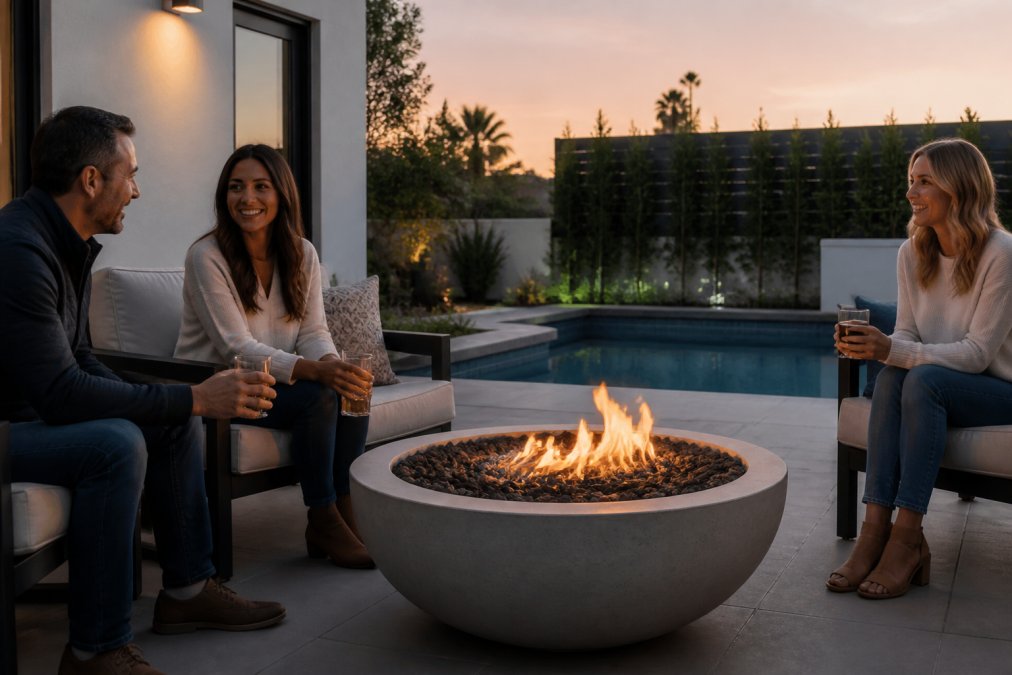
El Dorado fire bowls have become a fixture in Southern California backyard design for one practical reason: they solve the problem most fire features create. Steel rusts near the coast and cheap bowls crack, but a well-made glass fiber reinforced concrete bowl handles salt air and keeps its finish.
GFRC Construction: What Makes These Fire Bowls Weather-Resistant
Glass fiber reinforced concrete (GFRC) mixes cement, sand, water, and alkali-resistant glass fibers into a thin, strong shell far lighter than poured concrete. The fibers resist the hairline cracking caused by thermal expansion and coastal humidity swings.
Smooth Concrete Texture vs. Decorative Rim Options
Finish choice is where most buyers get stuck. Smooth concrete reads modern and pairs with clean-lined hardscape; decorative rims add visual weight and hide water spotting better.
Fuel Options: Natural Gas vs. Liquid Propane El Dorado Fire Bowls
Fuel choice locks in everything downstream, where the bowl can sit, who signs off on the install, and how the flame behaves on a cold night. Most product pages list "NG or LP" and move on; the real answer depends on your site, your burner, and how you'll use the feature.
| Factor | Natural Gas | Liquid Propane |
|---|---|---|
| Fuel source | Permanent gas line from meter | Tank or cylinder on site |
| Refueling | None, continuous supply | Periodic tank swap or refill |
| Placement flexibility | Fixed once tied in | Can be relocated with tank |
| Installation scope | Licensed gas contractor, pressure test, shutoff valve | Regulator, tank, ventilation, safe storage |
| Flame consistency | Steady as line pressure holds | Drops as tank empties; regulator matters |
| Best for | Patios with existing gas or planned gas runs | Sites without gas, or movable features |
Fuel Conversion Kits: What Actually Changes
A common question at the design center is whether a propane bowl can be switched to natural gas later, or vice versa. Usually yes, but only with the manufacturer's conversion kit for that exact model, and it's not just a hose swap.
What changes in a conversion:
- Burner orifices. Natural gas and propane require different orifice sizes because they deliver fuel at different pressures and energy densities. Running propane through a natural-gas orifice (or the reverse) produces a weak, sooty, or unsafe flame.
- Air-to-fuel mixture. The burner's air shutter or mixing collar is set for one fuel. Conversion kits include the correct setting or a replacement component.
- Regulator and supply pressure. Propane typically runs at higher delivery pressure than natural gas. The regulator, and sometimes the hose or flex line, is matched to the fuel.
- Control valve and ignition. Some electronic ignition modules are fuel-specific; confirm the kit covers the ignition side, not just the burner.
BTU Output and Heat Radius: Sizing by Seating Distance, Not Flame Height
BTU rating tells you how much heat the burner produces; heat radius tells you how far that heat reaches a seated person. They're related but not the same, and the gap between them is where most sizing mistakes happen.
A few practical patterns most installers work from:
- Ambiance-first bowls (smaller diameter, lower BTU) throw a visible flame but little radiant heat past a few feet. Good for accenting a pool edge or a walkway.
- Conversation bowls (mid-size, moderate BTU) are sized so seated guests within roughly arm's reach of the bowl feel warmth on a cool evening.
- Large-format bowls (wide diameter, high BTU) can warm a broader seating arc, but only if the burner is matched to the bowl's interior volume, an oversized burner in a small bowl just wastes fuel and shortens media life.
Gas Fire Bowl Installation Requirements for Residential Projects
Gas fire bowl installation comes down to three things: a properly sized gas line, correct clearances from combustible surfaces, and a level, stable base. Get any wrong and you're redoing hardscape, or worse.
The Gas Line: Sizing, Testing, and Who Does the Work
The gas line must be sized for the burner's demand, not just "big enough to reach." An undersized line produces a weak flame, delayed ignition, or a burner that won't stay lit in wind. Sizing depends on the burner's rated input, the run length from the meter, and the pressure at the connection point.
A licensed gas contractor handles the run, the pressure test, and the final connection. Two details worth confirming before the trench is backfilled:
- Shutoff valve location. It needs to be accessible, not buried behind finished hardscape, so the bowl can be isolated for service or in an emergency.
- Drip leg or sediment trap. Many jurisdictions and manufacturers call for one to keep debris out of the burner orifice. Confirm with your contractor whether it's required.
Safety Clearances and Combustible Surfaces: The Detail Most Guides Skip
Clearance is the requirement most often ignored and the one that matters most. "Clearance to combustibles" means the minimum distance between the bowl, burner, flame, and heated shell included, and any material that can ignite or degrade from heat.
What counts as a combustible surface:
Request a Design Consultation →
- Wood pergolas, beams, and posts
- Composite decking and railing systems
- Fabric shade sails, umbrellas, and curtains
- Wood or composite furniture placed too close
- Vinyl fencing and some synthetic wall panels
- Mulch, dry plant material, and artificial turf near the base
A practical workflow:
- Get the manufacturer's installation manual for the exact model before finalizing hardscape drawings.
- Note the stated clearance to combustibles and any clearance to non-combustibles.
- Note any overhead clearance requirement, a pergola or roof soffit above the bowl is a separate dimension from side clearance.
- Cross-check against your local building department's requirements, which may be stricter.
- Mark the clearances on the hardscape plan so the contractor frames to them, not to the bowl's footprint.
Base and Mounting: Level, Stable, and Rated for the Load
A fire bowl needs a flat, solid surface, a wobbly bowl stresses the burner assembly, gas connection, and finish. On a raised wall or column, the structure beneath must be designed for the bowl's weight plus the fire media, since lava rock and fire glass are heavier than they look.
Ventilation and Drainage
Gas fire bowls need airflow. The burner consumes oxygen and produces combustion byproducts, and most bowls have ventilation built into the base or shell. Don't block those openings with media, hardscape, or decorative panels. If the bowl sits in a recessed niche or under a solid cover, confirm with the manufacturer that the configuration is approved.
Ignition Systems and Remote Control Operation
Electronic ignition is standard on quality gas fire bowls and worth the upgrade. Push-button or remote start lights the burner without a match, and many systems include flame adjustment so you can dial the fire down for a quiet evening.
Maintaining Your Fire Bowl in Coastal Orange County
Coastal air is hard on outdoor metal and concrete, and this is where El Dorado fire bowls earn their keep. The GFRC shell resists salt and moisture far better than steel, but it still needs a routine.
A simple maintenance rhythm:
- Rinse the bowl and wipe the rim monthly to remove salt film
- Clear the burner ports of debris, spider webs, and dust before each season
- Check the ignition electrode and clean it if the flame is slow to light
- Inspect the gas connection and shutoff valve annually
- Reapply sealer as the finish dulls, more often near the coast
- Cover the bowl when it's out of use to slow weathering
Choosing the Right Size and Fire Media for Your Outdoor Living Space
Size and fire media decide how the finished feature looks and feels. Get the bowl diameter right for the seating area, then pick media that matches the flame you want.
Fire media options:
- Lava rock gives a natural, rugged look and hides the burner well
- Fire glass reflects the flame and suits modern, clean-lined patios
- Decorative media can tie the bowl to your tile and stone palette
Frequently Asked Questions
What are the benefits of using concrete fire bowls in outdoor design?
Concrete fire bowls, especially those made from glass fiber reinforced concrete (GFRC), offer durability and design flexibility. GFRC is lightweight yet strong, making it easier to position than traditional cast concrete. These fire bowls are weather-resistant, which matters in coastal climates, and they come in various finishes and sizes to complement hardscape design. They serve as a focal point for an outdoor living space while providing warmth and extending patio usability into cooler evenings.
Are gas fire bowls safe for use on wooden decks?
Gas fire bowls can be used on wooden decks, but specific installation clearance requirements must be followed. Manufacturers typically specify a minimum clearance from combustible surfaces, and a heat shield or non-combustible base may be required. Always check the manufacturer's guidelines and local building codes. A professional installer can confirm safe placement and ensure proper ventilation. Never place a fire bowl directly on a wooden surface without verifying clearance requirements.
What is the difference between natural gas and propane fire bowls?
Natural gas fire bowls connect to a home's gas line, providing a continuous fuel supply without tanks. Propane models require a tank and may need refilling, but they offer portability if you want to move the bowl. BTU output can vary between fuel types, affecting heat radius. Natural gas is often preferred for permanent installations, while propane suits areas without a gas line. Both require proper installation and safety checks.
How do I maintain a concrete fire bowl in a coastal climate?
In coastal Orange County, salt air and moisture can affect outdoor features. For GFRC fire bowls, clean the surface regularly with mild soap and water to prevent salt buildup. Inspect the burner assembly and ignition system for corrosion or debris. Cover the bowl when not in use to protect it from moisture. Check for cracks or chips, especially after winter storms. A durable finish helps resist fading, but periodic sealing may be recommended by the manufacturer.