
Table of Contents
- What Separates a High End Fire Pit Design From a Basic One
- Quick Comparison: Five Fire and Water Bowls Reviewed
- Maya Linear Fire and Water Bowl: The Copper Statement Piece
- Nile Fire and Water Bowl: Largest Copper Bowl in the Lineup
- Roma and Luna Fire and Water Bowls: GFRC Concrete Value Picks
- Square Maya Fire & Water Bowl: A Modern Silhouette With Electronic Ignition
- Modern Outdoor Fire Pit Design Trends Shaping 2026 Backyards
- Luxury Fire Feature Installation Best Practices
- Frequently Asked Questions
Last Updated: September 20, 2026
What Separates a High End Fire Pit Design From a Basic One
A high end fire and water feature combines a stainless steel burner, a recirculating water system, and one of the fire pit designs that anchors a backyard into a single focal point. What separates it from a basic fire pit: vessel material, ignition system, how the water moves, and whether it survives coastal air for a decade.
Quick Comparison: Five Fire and Water Bowls Reviewed
| Model | Material | Ignition | Price | Best For |
|---|---|---|---|---|
| Maya Linear | Copper | Match lit or electronic | $4,707.00 | Linear statement pieces |
| Nile | Copper | Match lit or electronic | $6,641.00 | Largest copper bowl |
| Roma | GFRC concrete | Match lit or electronic | $2,606.00 | Value entry point |
| Luna | GFRC concrete | Match lit or electronic | $2,819.00 | Color matching |
| Square Maya | GFRC concrete | Low voltage electronic | $6,752.00 | Modern square silhouettes |
How This Review Was Evaluated
We looked at material durability, ignition options, fuel compatibility, and finish choices. Every model runs on natural gas or propane and includes a lava rock burning display, with fire glass as an option. Copper patinas over time; GFRC holds a color finish. Neither is better, they just age differently.

Maya Linear Fire and Water Bowl: The Copper Statement Piece
The Maya Linear is the pick when the feature needs to read as a long, low focal point rather than a round bowl. Copper construction, stainless steel burner, waterfall edge, match lit or electronic ignition, natural gas or propane, made in the United States.
The honest limitation is copper itself. It will patina.
Nile Fire and Water Bowl: Largest Copper Bowl in the Lineup
The Nile is the biggest copper bowl in this group, built for clients who want water and flame to dominate the sightline. Same construction as the Maya Linear: copper vessel, stainless steel burner, waterfall edge, match lit or electronic ignition, natural gas or propane, made in the United States.

Roma and Luna Fire and Water Bowls: GFRC Concrete Value Picks
These two are the practical answer for most projects: glass-fiber reinforced concrete with a stainless steel burner, match lit or electronic ignition, and natural gas or propane.
Square Maya Fire & Water Bowl: A Modern Silhouette With Electronic Ignition
The Square Maya is a 24-inch square bowl in GFRC concrete with a metallic slate finish and low voltage electronic ignition. Its squared silhouette suits modern landscape architecture better than a round bowl does.

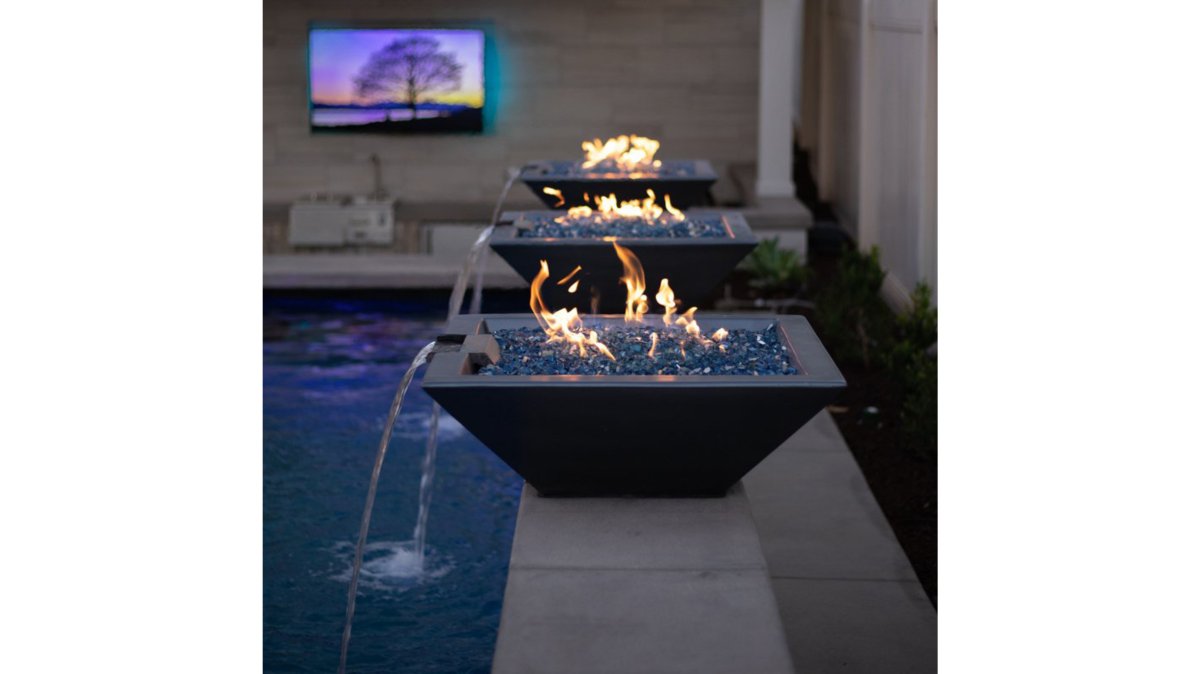
Electronic ignition is standard here rather than optional.
Modern Outdoor Fire Pit Design Trends Shaping 2026 Backyards
Three forces are reshaping how fire and water features get specified right now, each with a practical consequence for the trades and homeowners alike.
Fire and Water in One Vessel
The single biggest shift is consolidation: instead of a fire pit on one side of the patio and a separate water feature on the other, designers are specifying one vessel that does both. A combined feature uses one gas line, one electrical run, and one water loop instead of two of each, simplifying the rough-in and reducing the systems a homeowner maintains.
Linear and Square Silhouettes Replacing Round Bowls
Round fire pit designs dominated for years because they are forgiving: a round bowl looks correct from any angle and needs no alignment to a patio grid. Linear and square silhouettes are taking over on modern builds because they echo the geometry of the architecture, long pool walls, rectilinear planters, square fire tables.
Finish Matching Over Finish Contrast
The third trend is finish matching: choosing the bowl color to tie into the hardscape, stucco, or pool coping rather than stand apart from it. GFRC concrete makes this practical because it holds a color finish across a wider range than copper, which patinates on its own schedule. The result reads as built-in rather than added on.
The Practical Driver Behind All Three
Trends aside, the feature that gets serviced is the feature that lasts. Burners and pumps reachable from above get inspected, cleaned, and replaced on schedule; features that require disassembly to reach the pump get ignored until they fail. When comparing models, ask how the pump and burner are accessed.
When specifying for a client, bring the hardscape and stucco samples to the showroom rather than choosing a finish from a screen. Coastal light and evening landscape lighting both change how a concrete color reads, and a mismatch is expensive to correct after the base is set.
Maya Linear Fire and Water Bowl →
Luxury Fire Feature Installation Best Practices
Luxury fire feature installation best practices start with one rule: the gas, water, and electrical rough-ins get designed before the first form is set. Every model here runs on natural gas or propane, and every waterfall bowl needs a water source, a reservoir, and a recirculation path.
Gas Supply and Burner Sizing
Size the gas line to the burner's rated BTU input, not to the nearest available stub. Confirm the burner's BTU rating with the manufacturer's spec sheet, then have a licensed professional size the gas line to deliver that volume at the required pressure over the actual run length. Long runs and multiple appliances on one meter both reduce delivered pressure.
Water System: Pump, Reservoir, and Recirculation
A waterfall bowl is a closed-loop system. Water spills over the rim, collects in a reservoir below the burner, and a pump pushes it back up. Three components matter:
- Reservoir capacity. Too small and the pump runs dry between top-offs.
- Pump sizing. Match the pump's flow rate to the spillway width. An oversized pump on a narrow spillway splashes; an undersized pump produces a dribble instead of a sheet of water.
- Fill point and overflow. Every reservoir needs an accessible fill point and, ideally, an overflow path so heavy rain does not flood the burner pan.
Electrical and Ignition Control
Low voltage electronic ignition needs a transformer and a switched power source. Match-lit bowls need nothing electrical, which is why they remain the right call for remote or hard-to-wire locations. If the feature sits far from the house, run conduit in the same trench as the gas line.
Sequencing the Rough-Ins
The order that avoids rework:
- Finalize the feature model and its BTU, flow, and voltage requirements.
- Have a licensed professional size and stub the gas line.
- Run the water supply (if not tied to the pool) and the electrical conduit in the same trench.
- Pour the base and set the reservoir.
- Set the bowl, connect the burner, and commission the system.
The cheapest time to run gas, water, and electrical to a fire feature is before the patio is poured.
If you are specifying for a client, pull the manufacturer's installation manual before the design is finalized, not after. The clearances, BTU requirements, and voltage specs in that document are what your trades need to bid the job accurately.
Long-Term Maintenance and Winterization
Copper and concrete age differently, and both need a routine. Copper develops a patina and should be left to do so unless the client wants it polished. GFRC benefits from a periodic clean and, in coastal Orange County, a rinse to remove salt buildup. Salt air accelerates corrosion on fasteners and burner components.
Fuel Consumption and Operating Cost
Two systems run on every dual-element feature: the burner and the pump. The burner's consumption depends on its BTU rating and runtime; the pump's on its wattage and runtime. Homeowners often underestimate the pump's continuous draw because it runs whenever the water feature is on, not just when the flame is lit. If operating cost matters to the client, ask the manufacturer for the burner's BTU input and the pump's rated wattage, then apply the client's current utility rates to a realistic runtime estimate.
Frequently Asked Questions
What are the best luxury fire pits for a backyard with a pool?
A fire and water bowl placed near a pool works best because it combines two focal points. Copper models like the Maya Linear and Nile Fire and Water Bowls resist coastal air and include stainless steel burners, while the Roma and Luna use glass-fiber reinforced concrete for a lighter budget. All five run on natural gas or propane and offer match lit or electronic ignition, so choose based on patio size and how often you want to adjust the flame.
What are the key design considerations for integrating fire and water features?
Plan the water spill direction first, since it determines how close the bowl can sit to seating and walkways. Check the gas line size and electrical run before hardscaping begins, because retrofitting after pavers are set adds cost. Match the bowl material to your climate: copper patinas naturally, while GFRC concrete holds a painted finish. Finally, confirm the burner's BTU output suits the size of the outdoor living space you are heating.
What is the current trend in fire pit designs for 2026?
Square and linear silhouettes are replacing round bowls as the centerpiece of modern patio layouts. Buyers want low-voltage electronic ignition tied into smart controls, water spillways that double as scuppers, and neutral finishes like metallic slate that read as architectural rather than rustic. Fire glass is replacing lava rock in contemporary builds, and designers increasingly treat the fire and water bowl as one element within a larger hardscaping plan rather than a standalone purchase.
How does professional design visualization help in planning fire and water features?
A rendering shows how the bowl's scale, flame height, and spill width will look against your actual patio dimensions before anything is ordered or built. It also flags placement problems early, such as a water spill aimed at a walkway or a gas run that cannot reach the intended spot. BellaFina Outdoors offers design and visualization support at its Huntington Beach showroom, so homeowners, designers, and contractors can review products and layouts together before construction starts.
Are there specific safety standards for fire and water feature proximity?
Clearances are governed by local building and fire codes, and requirements vary by jurisdiction, so confirm them with your local permitting authority before finalizing placement. As a general practice, keep open flames away from low-hanging vegetation, combustible furniture, and covered structures, and have a licensed gas professional handle the supply line and connections. Electronic ignition models add a safety shutoff that match lit bowls do not have.