
Table of Contents
- What Orange County Homeowners Should Know Before Hiring Outdoor Kitchen Contractors
- How to Vet and Compare Outdoor Kitchen Contractors: A Checklist
- Outdoor Kitchen Permit Requirements You Need to Understand
- How Outdoor Kitchen Design Services Improve Project Outcomes
- Outdoor Kitchen Appliance Selection: What to Specify Before You Build
- Materials, Finishes, and Durability in a Coastal Climate
- Budgeting, Timelines, and ROI for Your Outdoor Kitchen Project
- Conclusion
Last Updated: August 22, 2026
Hiring outdoor kitchen contractors is one of the more consequential decisions you'll make during a backyard renovation. Get it right and you end up with a functional, beautiful outdoor living space that adds real value to your home. Get it wrong and you're dealing with failed gas line installations, unpermitted structures, and a project that costs twice what you budgeted. At Bellafina Outdoors, we work closely with homeowners, contractors, and designers throughout Orange County, and we see the downstream effects of both good and bad contractor decisions every single time.
Below, we'll walk through exactly what to look for when vetting outdoor kitchen contractors, how to approach permits and design, which appliances and materials to specify before construction begins, and how to set realistic expectations around timelines and budget.
What Orange County Homeowners Should Know Before Hiring Outdoor Kitchen Contractors
Outdoor kitchen contractors vary enormously in scope, specialization, and quality. Some are general contractors who occasionally build outdoor kitchens. Others specialize exclusively in outdoor living spaces. A smaller number offer integrated design-build services that handle everything from initial layout through final installation.
A well-executed outdoor kitchen involves masonry work, structural framing, gas line installation, electrical safety compliance, drainage and plumbing, and often pergola and shade structures. A contractor who can't explain how they coordinate subcontractor work is a contractor who will cause scheduling headaches later. Project management is the skill that separates average contractors from excellent ones.
Why Coastal Conditions Change the Conversation
Coastal Orange County presents conditions that genuinely narrow your material and contractor options. Salt air accelerates corrosion on metals, degrades certain sealants faster than inland climates, and creates specific demands for weather-resistant materials that not every contractor accounts for in their standard builds.
A contractor who builds primarily in inland communities may spec materials that perform well in those environments but deteriorate faster near the coast. When interviewing contractors, ask directly whether they have completed projects within a mile or two of the coast, and ask to see photos. Coastal construction experience is a genuine differentiator.
How to Vet and Compare Outdoor Kitchen Contractors: A Checklist
Most contractor vetting guides stop at "check their license and read reviews." That's a floor, not a ceiling. Here's a more complete framework for evaluating outdoor kitchen contractors before committing to a project estimate or signing a contract.
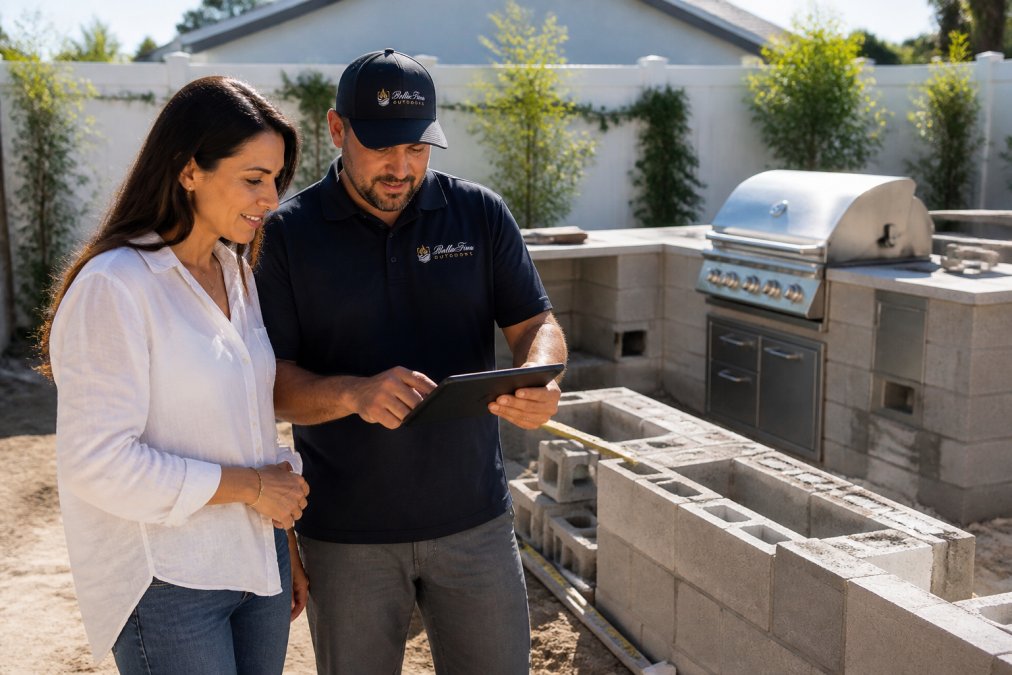
Pre-hire checklist:
- Verify current California contractor license through the CSLB
- Confirm they carry general liability insurance and workers' compensation
- Request a minimum of three completed outdoor kitchen references
- Ask for photos of projects in coastal environments specifically
- Confirm they will pull all required permits
- Ask how they handle subcontractor coordination for gas, electrical, and plumbing
- Request a written project timeline with milestones
- Understand their warranty coverage on both labor and materials
- Clarify who is responsible for site assessment and structural integrity evaluation
- Get a detailed written project estimate that breaks out labor, materials, and subcontractor costs separately
A contractor who resists providing any of the above in writing is telling you something important.
Verifying Contractor Licensing in California
California requires all contractors performing work valued over $500 to hold a valid license issued by the California Contractors State License Board. You can verify any contractor's license status, classification, and disciplinary history directly through the CSLB's online lookup tool in about two minutes.
For outdoor kitchen projects, the relevant license classifications typically include Class B (General Building Contractor) and potentially Class C specialty licenses for gas, electrical, or plumbing work. Confirm that all subcontractors are also licensed through the CSLB. An unlicensed contractor performing work above the $500 threshold is operating illegally and creates legal exposure for the homeowner.
Questions to Ask Before Signing Anything
Beyond the checklist, a few targeted questions reveal a contractor's actual competence and communication style:
- "Walk me through how you handle a project where the site assessment reveals something unexpected, like poor drainage or a gas line in a different location than expected."
- "Who specifically will be on-site managing the work day to day, and how often will I hear from them?"
- "What does your warranty cover, and how do I initiate a warranty claim if something fails after installation?"
- "Have you worked with a design center or designer-supplied specifications before, and how do you handle product specs from a third party?"
That last question matters more than it might seem. Contractors accustomed to working with designer-supplied plans and product specifications tend to execute more cleanly because the decisions are made before construction begins, not during it.
Outdoor Kitchen Permit Requirements You Need to Understand
Outdoor kitchen permit requirements are determined at the local jurisdiction level, meaning the rules in Huntington Beach may differ from those in Irvine, Newport Beach, or Anaheim. Most jurisdictions in Orange County require permits for built-in appliances, gas line installation, electrical work, and any structural construction including masonry or concrete block.
Outdoor kitchen permit requirements typically cover:
- Gas line installation: Any new gas line or modification to an existing line requires a permit and inspection by your local building department.
- Electrical work: Outdoor lighting design, outlet installation, and any electrical connections for appliances require permitted work by a licensed electrician.
- Structural construction: Masonry work, concrete block construction, and any structural framing typically require a building permit and may require engineering review depending on scope.
- Drainage and plumbing: If your outdoor kitchen includes a sink or any plumbing connections, a plumbing permit is generally required.
According to the California Building Standards Commission, residential construction must comply with the California Building Code, which establishes minimum standards that local jurisdictions can exceed but not undercut. Always verify current requirements with your specific city's building department before starting any project.
The practical consequence of skipping permits isn't just a fine. Unpermitted structures complicate home sales, can void homeowner's insurance coverage for incidents related to those structures, and may require demolition and reconstruction at your expense.
How Outdoor Kitchen Design Services Improve Project Outcomes
Outdoor kitchen design services move decisions from the construction phase to the planning phase. A contractor who breaks ground without a finalized layout is essentially making design decisions in real time, and those decisions get more expensive the further into construction they occur. Finalizing your outdoor kitchen layout, appliance specifications, countertop materials, and finish selections before construction begins gives your contractor a complete set of instructions to execute rather than a rough concept to interpret.
Visualizing Your Layout Before Construction Begins
Realistic renderings of your outdoor living space solve a specific problem: the gap between what you imagine and what you'll actually get. Many homeowners approve a layout on paper only to realize during construction that the grill station is too close to the seating area, or that the fire pit integration blocks the view they wanted to preserve.
At Bellafina Outdoors, our design and visualization services produce realistic renderings that show your actual backyard with the specific products, finishes, and layout you're considering. This gives you the ability to make changes before a single block is laid, which is when changes are free rather than expensive.
Request a Design Consultation →
Outdoor Kitchen Appliance Selection: What to Specify Before You Build
Outdoor kitchen appliance selection is one of the most consequential decisions in the entire project, and it needs to happen before construction begins, not after the countertops are poured.
Built-in appliances have specific rough-in dimensions, ventilation requirements, gas connection specifications, and electrical needs. If you spec a grill with a 36-inch cutout after the masonry is already built to accommodate a 30-inch unit, you're looking at demolition and reconstruction. Appliance selection drives construction, not the other way around.
Key categories to specify before breaking ground:
- Grill station: Built-in grills vary significantly in BTU output, burner configuration, and cutout dimensions. Confirm gas connection type and verify your contractor's gas line installation plan matches the appliance spec.
- Refrigeration: Outdoor-rated refrigerators are not the same as indoor units. Confirm the appliance is rated for ambient temperatures in your climate range.
- Side burners and accessories: These affect counter space allocation and gas manifold sizing.
- Fire pit integration: If you're incorporating a fire feature into the kitchen island, the gas supply needs to be sized to handle all appliances running simultaneously.
- Outdoor lighting design: Specify lighting placement and electrical requirements before countertops are installed, since conduit routing is significantly easier during rough framing.
According to the National Fire Protection Association's guidelines on outdoor gas appliances, proper clearances between gas appliances and combustible materials are a safety requirement. Your contractor should be familiar with these standards, and your appliance specifications should include manufacturer-specified clearance requirements.
| Appliance Category | Key Spec to Confirm Before Build | Common Mistake |
|---|---|---|
| Built-in Grill | Cutout dimensions and gas connection type | Ordering appliance after masonry is complete |
| Outdoor Refrigerator | Outdoor ambient temperature rating | Using an indoor-rated unit outdoors |
| Fire Feature | Gas supply sizing for simultaneous use | Undersized gas line serving multiple appliances |
| Lighting | Conduit routing and electrical load | Running conduit after countertops are poured |
| Side Burner | Counter space allocation | Insufficient counter clearance on either side |
Materials, Finishes, and Durability in a Coastal Climate
Material selection for a coastal outdoor kitchen is where the difference between a 5-year project and a 20-year project gets decided. Salt air, UV exposure, and moisture cycling create conditions that accelerate failure in materials that perform well in other climates.
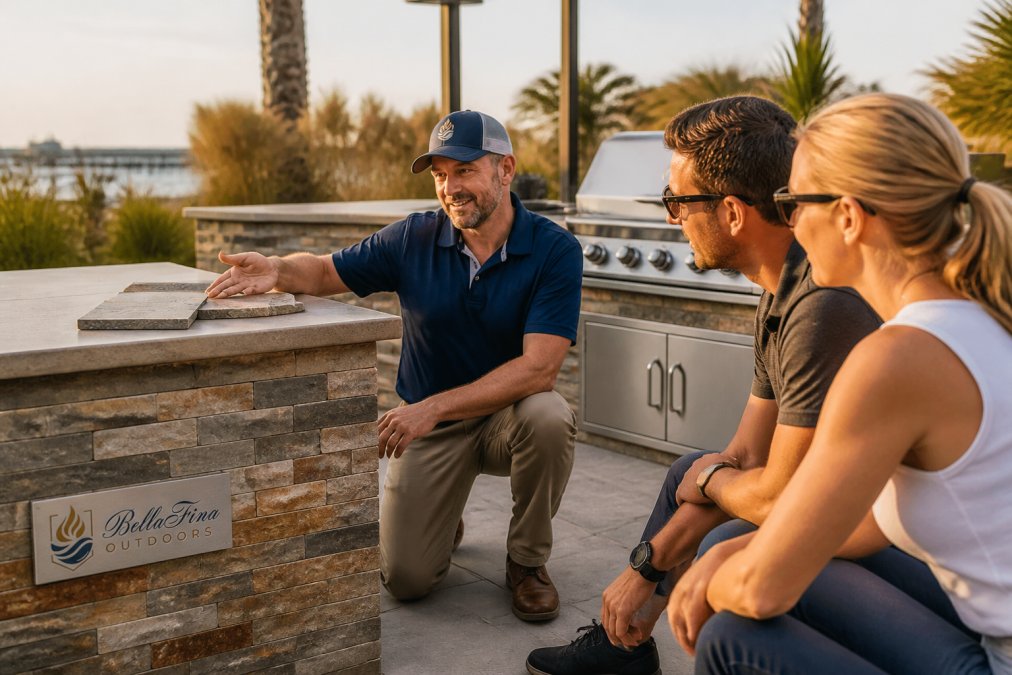
Stone veneer and cladding: Natural stone ledgerstone panels are among the most durable options for outdoor kitchen islands in coastal environments. Stone doesn't corrode, doesn't fade from UV exposure the way painted surfaces do, and develops character over time rather than degrading. Bellafina Outdoors carries ledgerstone panels in several finishes suited to coastal Southern California aesthetics, including Antico Natural Stone panels, Ivory ledgerstone, Shellstone, and Silver ledgerstone, all in the 6x24 format that works well for both horizontal and vertical applications on outdoor kitchen islands.
Countertops: Porcelain and concrete are the most common choices for coastal outdoor kitchens. Porcelain offers excellent resistance to salt air and UV without the maintenance burden of natural stone.
Cabinetry: Custom cabinetry for outdoor kitchens should be built from materials rated for exterior use. Marine-grade stainless steel or polymer-based cabinet systems outperform wood-based alternatives in coastal conditions.
Stainless steel appliances: Not all stainless steel performs equally in coastal environments. Grade 316 stainless steel offers significantly better corrosion resistance than the more common Grade 304. Confirm the grade with your appliance supplier before purchasing.
Budgeting, Timelines, and ROI for Your Outdoor Kitchen Project
Getting a realistic project estimate early, and understanding what drives cost, puts you in a much stronger negotiating position.
What drives outdoor kitchen project costs:
- Scope and complexity: A basic grill station with a countertop and stone veneer cladding costs significantly less than a full outdoor kitchen with custom cabinetry, multiple built-in appliances, fire pit integration, pergola and shade structures, and outdoor lighting design.
- Material selection: The difference between entry-level and premium materials in countertops, stone veneer, and appliances is substantial. Specifying materials before getting estimates allows for accurate comparison.
- Site conditions: Poor drainage, existing hardscape that needs removal, or gas and electrical infrastructure that requires significant extension all add to project cost. A site assessment before finalizing your budget is essential.
- Permit fees and inspections: Budget allocation should include permit costs, which vary by jurisdiction and project scope.
Timeline expectations:
A straightforward outdoor kitchen project, assuming permits are pulled promptly and materials are in stock, typically runs several weeks from construction start to completion. More complex projects involving custom cabinetry, extensive masonry work, or significant infrastructure work can run longer. Permit processing timelines vary by city and current building department workload.
ROI and property value:
Outdoor kitchens are consistently cited by real estate professionals as one of the higher-return outdoor improvements for residential properties. The National Association of Realtors' remodeling impact report tracks the appeal and cost recovery of various home improvement projects, and outdoor living improvements consistently rank well for both enjoyment value and resale contribution. A well-executed outdoor kitchen project adds usable square footage to your home's living space and extends the seasons in which your backyard is genuinely functional.
Planning an outdoor kitchen project involves more moving parts than most homeowners anticipate, from contractor vetting and permit compliance to material selection and design finalization. The projects that go smoothly are almost always the ones where those decisions were made before construction began, not during it. Bellafina Outdoors provides design and visualization services, premium product sourcing, and contractor support resources to help you arrive at the construction phase with a complete plan. Visit our Huntington Beach design center or request a design consultation to start your project with clarity rather than guesswork.
Frequently Asked Questions
Do you need a permit for an outdoor kitchen in California?
Yes, most outdoor kitchen projects in California require permits. Any work involving gas line installation, electrical connections, or structural changes, such as a pergola or masonry structure, typically triggers a building permit from your local municipality. In Orange County cities, you'll generally need separate permits for gas, electrical, and structural work. Your contractor should pull these permits; if they suggest skipping them, treat that as a red flag.
What questions should I ask before hiring an outdoor kitchen contractor?
Ask for their California Contractors State License Board (CSLB) license number and verify it at cslb.ca.gov. Confirm they carry general liability and workers' compensation insurance. Ask who handles subcontractor coordination for gas, electrical, and masonry work. Request a detailed written estimate with a project timeline. Ask for references from completed outdoor kitchen projects specifically, and find out whether they have experience with the permit process in your city.
How can 3D visualization help in the outdoor kitchen planning process?
Realistic design renderings let you confirm layout, appliance placement, material choices, and traffic flow before any construction begins. This is especially valuable when coordinating built-in appliances, countertop materials, and stone veneer finishes, because changes on paper cost nothing while changes mid-build cost significantly. Visualization also helps contractors and subcontractors align on scope, which reduces miscommunication and delays during the project.
What is the difference between a general contractor and a specialized outdoor kitchen installer?
A general contractor manages the full scope of construction and coordinates subcontractors for trades like gas, electrical, and plumbing. A specialized outdoor kitchen installer focuses specifically on grill stations, cabinetry, and appliance integration, but may not self-perform structural or utility work. For a full outdoor kitchen build with hardscape design, drainage, pergola structures, and gas line installation, a licensed general contractor with outdoor living experience typically provides better project management and accountability.
This article was written using GrandRanker