
Table of Contents
- Why Installation Requirements Matter More Than the Fire Feature Itself
- Outdoor Fire Pit Clearance Requirements: Setbacks and Combustible Materials
- Gas Fire Pit Installation Permit: What Your Local Jurisdiction Expects
- Step-by-Step Site Preparation and Foundation Guide
- Gas vs. Wood-Burning: Fuel Type Impacts on Installation Standards
- Custom Backyard Fire Pit Installation: Retrofitting vs. New Construction
- Inspection Checklist and Insurance Considerations
- Your Next Step: Planning With Confidence
- Frequently Asked Questions
Last Updated: September 6, 2026
Why Installation Requirements Matter More Than the Fire Feature Itself
A fire feature that fails inspection is a fire feature you cannot use. The outdoor fire feature installation requirements that govern setbacks, clearances, and fuel lines are not bureaucratic hurdles; they are the difference between a backyard centerpiece and a liability. Getting these details wrong can delay your project, void warranties, or create a genuine safety hazard in a space meant for relaxation.
At Bellafina Outdoors, we work with Orange County homeowners, contractors, and designers who are planning outdoor kitchens and fire features. The most common source of project friction is not product selection; it is discovering that the chosen location conflicts with code requirements or that the gas line needs modification. Understanding the rules before you fall in love with a specific design saves time, money, and frustration.
The core principle is simple: fire feature installation is governed by clearances to combustible materials, local building codes, and proper site preparation. Most top-tier fire pit inserts and bowls are engineered to strict standards, but they are only as safe as their installation.

Outdoor Fire Pit Clearance Requirements: Setbacks and Combustible Materials
The most critical outdoor fire pit clearance requirements involve the distance between the flame and anything that can burn. This includes your house siding, wooden fences, overhead tree branches, patio covers, and outdoor furniture. Standard guidance, which you should confirm with your local jurisdiction, often calls for a minimum of 10 to 20 feet from structures for wood-burning units, while gas units may have different, sometimes more flexible, requirements based on their design.
The distinction hinges on the concept of "clearance to combustibles." A gas fire pit with a proper burner pan and glass media radiates heat differently than an open wood fire. However, the rule of thumb is to never assume; always verify against the manufacturer's specifications and your local fire safety code.
You must also consider the surface below and around the unit. A non-combustible base, such as a concrete patio, pavers, or a gravel foundation, is essential. The area directly beneath the burner and extending outward should be free of dry grass, mulch, or other organic material that could ignite from stray sparks or radiant heat.
Gas Fire Pit Installation Permit: What Your Local Jurisdiction Expects
A gas fire pit installation permit is almost always required when your project involves a new gas line or a gas line modification. This is not a DIY-friendly gray area; connecting a fire feature to your home's gas supply involves working with combustible fuel under pressure. Most jurisdictions mandate that a licensed professional handle the gas line work, from the shut-off valve to the burner connection.
The permit process typically involves submitting a site plan that shows the fire feature's location, its distance from structures, and the proposed gas line route. Your local jurisdiction will review the plan for compliance with installation standards, including gas pressure regulation and the placement of an accessible gas shut-off valve.
A common misconception is that a permit is only needed for permanent, built-in structures. Even some portable units that are connected to a natural gas line require a permit because the gas line modification itself is the trigger for inspection. The inspection usually verifies the integrity of the gas connection and confirms there are no leaks. The International Code Council's guide on residential fire features outlines baseline standards that many local codes adopt or adapt, making it a useful reference point for what your inspector will check.
Step-by-Step Site Preparation and Foundation Guide
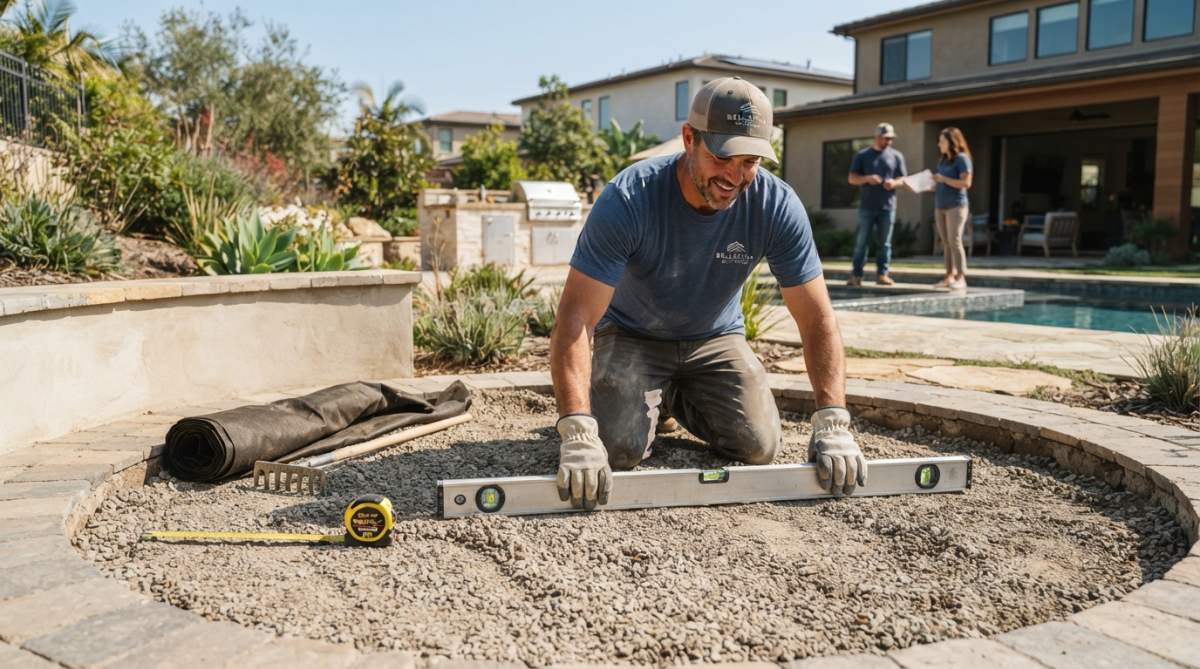
Once your location is confirmed and your permit is in hand, the physical work begins with the ground. Fire feature installation demands a stable, level, and non-combustible foundation. A wobbly fire bowl or a paver patio that settles unevenly compromises both the look and the structural integrity of your unit.
Here is a practical sequence for site prep:
- Mark and Excavate: Outline the footprint of your fire feature plus a comfortable safety margin. Excavate to a depth that allows for a proper base, typically 4 to 6 inches for a gravel foundation on top of compacted soil.
- Lay the Gravel Foundation: Add crushed rock or gravel and compact it in layers. This creates a drainage system that prevents water from pooling under your unit, which is critical for the longevity of both concrete and metal components.
- Set the Base Material: For a paver base or a poured concrete pad, ensure the surface is perfectly level. Use a long level and check it in multiple directions. This is the non-negotiable step that ensures your fire pit bowl sits flush and your enclosure doors align.
- Run the Utility Lines: This is the point where the gas line or electrical conduit is routed to the unit's location. This step must be completed by a licensed professional and inspected before you cover it with your final hardscape installation.
Gas vs. Wood-Burning: Fuel Type Impacts on Installation Standards
The choice between a wood-burning fire pit and a gas unit is not just about ambiance; it fundamentally changes the installation standards and the level of complexity involved.
Wood-burning units are simpler in terms of utility connections, as they require no gas line or electrical hookup. However, they demand greater clearance to combustibles due to flying sparks and higher radiant heat. They also produce smoke, which can be a nuisance in densely populated neighborhoods and may be regulated by local air quality rules. The foundation requirements are similar, but the siting flexibility is often more restricted.
Request a Design Consultation →
Gas fire pits, conversely, shift the complexity from the fire bowl to the infrastructure. They require a gas line modification, a licensed professional for the hookup, and careful attention to gas pressure regulation. The benefit is a cleaner burn, instant on/off control, and more flexible placement options, provided you meet the smaller clearance requirements typical of low-BTU gas burners. You also need to decide between natural gas and liquid propane, as each has distinct storage and connection needs.
| Fuel Type | Utility Work Required | Clearance to Combustibles | Best For |
|---|---|---|---|
| Wood-Burning | None (no gas line) | Larger setbacks (10-20 ft typical) | Rustic look, open flame feel, no gas line access |
| Natural Gas | Gas line modification by pro | Smaller, per manufacturer spec | Convenience, seamless integration, no tank to refill |
| Liquid Propane | Tank placement + regulator | Similar to natural gas | Portability, or when a gas line is not feasible |
Custom Backyard Fire Pit Installation: Retrofitting vs. New Construction
Planning a custom backyard fire pit installation requires a different approach depending on whether you are building from scratch or adding to an existing space. For new construction, the fire feature can be integrated into the overall site plan from day one. Utility lines can be run efficiently, the foundation can be tied into the overall hardscape design, and the aesthetic can be fully coordinated with the surrounding landscape. This is where Outdoor living design and visualization support becomes invaluable, helping you see exactly how the fire feature will interact with your patio, seating, and lighting before a single shovel hits the ground.
Retrofitting a fire feature into an established backyard is where the real challenges surface. The primary constraint is access to utilities. Trenching a new gas line through an existing paver patio, root system, or concrete slab adds significant cost and labor. The location of your fire feature is often dictated by where the gas line can be run with the least disruption.
A strategic approach for retrofits is to build the fire feature as a focal point of a new seating area. This allows you to design the new hardscape to conceal the utility work. If you are working with an existing concrete patio, a raised fire pit enclosure can sit on top of the slab, with the gas line routed along the edge and boxed in, avoiding the need to core-drill through the concrete.
Inspection Checklist and Insurance Considerations
Before you light that first fire, a final review protects your investment and your safety. This is the step that separates a professional installation from a problematic one. Use this checklist to walk the project with your contractor or inspector.
- Gas Line Integrity: Confirm the gas line was pressure-tested and that a licensed professional performed the connection. Is there an accessible gas shut-off valve dedicated to the fire feature?
- Clearance Verification: Measure the distance from the burner to all combustible materials, including overhead structures, fences, and house eaves. Does it meet the manufacturer's spec and local code?
- Foundation Stability: Is the unit perfectly level on a non-combustible base? Is there proper drainage to prevent water accumulation around the base?
- Ventilation and Airflow: For enclosures, are there adequate ventilation requirements met to prevent gas accumulation? This is critical for built-in units with doors.
- Burner Test: With the gas on, do all burner ports light evenly? Is the flame height appropriate and stable, without excessive yellow tipping which indicates incomplete combustion?
Insurance is another layer of protection. Most standard homeowners' policies cover permanently installed fire features, but it is wise to inform your provider of the addition. Some carriers may have specific questions about the type of unit and its installation. A permitted and inspected installation is far easier to insure than one done without oversight. Confirm that any warranty on your fire pit insert or bowl is not voided by the installation method. The National Fire Protection Association's outdoor fire safety guidance offers a solid framework for understanding fire hazard mitigation, which is what insurers and inspectors are ultimately evaluating.
Your Next Step: Planning With Confidence
Navigating outdoor fire feature installation requirements can feel like a maze of codes and clearances, but it is a solvable puzzle. The path to a successful project is straightforward: research your local codes first, secure the right permits, hire licensed professionals for gas line work, and invest in a proper foundation. When you prioritize safety compliance and structural integrity from the start, the result is a fire feature that is both beautiful and worry-free.
This is where a trusted resource makes all the difference. At Bellafina Outdoors in Huntington Beach, our team helps you select from a curated collection of premium fire features and bowls, like the modern Bayside Fire Pit or the striking Square Maya Fire & Water Bowl, that are engineered for performance. We provide the product expertise and design visualization support to help you plan a fire feature that meets code and exceeds your expectations, long before construction begins.

Get started with Bellafina Outdoors and request a design consultation to bring your outdoor vision to life with confidence.
Frequently Asked Questions
How far should an outdoor fire feature be from your house?
Most local fire codes require a minimum of 10 feet from your house or any structure to a fire feature, though some jurisdictions require more for wood-burning units. You also need clearance from property lines, overhead structures, and trees. Always confirm with your local building department, since requirements vary by city. A licensed professional can help you determine the exact setback for your yard before you pour any concrete or run gas lines.
Do I need a permit for a permanent outdoor fire pit?
Yes, most permanent outdoor fire features require a building permit. A gas fire pit installation permit is typically required because the work involves gas line modification, which must be inspected for safety. Even wood-burning units often need permits due to clearance and enclosure requirements. Check with your local jurisdiction before starting. Installing without a permit can lead to fines, forced removal, and problems when you sell your home.
Can you put a fire pit directly on pavers?
You can place a portable fire pit on pavers, but a permanent fire feature needs a proper foundation. Pavers alone may shift or settle unevenly under the weight of a built-in unit. A non-combustible base, such as a gravel foundation topped with concrete, provides the structural integrity required for safe installation. The foundation must also account for drainage and frost heave, depending on your climate.
What are the ventilation requirements for gas fire features?
Gas fire features installed in enclosed areas, such as under a pergola or inside an outdoor room, require proper ventilation to prevent gas buildup and ensure complete combustion. The specific requirements depend on the BTU output of your burner and the enclosure size. An uncovered fire pit in an open backyard typically needs no additional ventilation. A licensed professional should assess airflow for any partially enclosed installation to meet fire safety code.