
Table of Contents
- Why Year Round Outdoor Living Ideas Start With a Plan
- Covered Patios, Pergolas, and Shade Structures
- Weatherproof Outdoor Kitchen Design for Every Season
- Custom Backyard Fire Pit Installation and Fire Features
- Outdoor Heating Solutions for Patios Beyond the Fire Pit
- Outdoor Lighting Design Tips for Evening Entertaining
- Hardscaping, Furniture, and Finishing Touches for Year Round Outdoor Living
- Conclusion
Last Updated: August 20, 2026
Most backyards sit empty nine months of the year, not because the climate won't cooperate, but because the space was never designed to work year-round. At BellaFina Outdoors, we see this pattern constantly: beautiful yards used for a few weeks in summer, then abandoned. The good news is that year round outdoor living ideas don't require a massive lot or unlimited budget. They require a plan, the right materials, and a clear understanding of how the space will actually be used.
Why Year Round Outdoor Living Ideas Start With a Plan
Outdoor living ideas that hold up across seasons start with a single question: what do you actually want to do out there? Entertaining, cooking, relaxing, swimming, gardening, each activity shapes the layout differently. A common mistake is designing around a single feature like a fire pit, then fitting everything else around it. The better approach is to map out zones first: dining, lounge, cooking, and transition spaces. Each zone has its own scale, clearance, and access requirements.
Space Planning for Smaller Backyards
Smaller backyards, roughly 800 square feet or less, benefit from vertical thinking. Built-in storage under bench seating, vertical gardening walls, and compact fire features make tight spaces feel considered rather than cramped. Scale matters: an oversized outdoor kitchen in a small yard makes the whole space feel unusable.
The key is choosing multi-functional elements. A dining table that doubles as a prep surface, a pergola that defines space and provides shade, a fire feature that serves as both focal point and heat source. None of this requires compromising on quality.
Permitting and Zoning: What to Check Before You Build
Covered patio structures, outdoor kitchens with gas lines, fire pits, and retaining walls above certain heights typically require permits in most jurisdictions. Specifics vary by city and county.
Before any contractor breaks ground, check with your local building department. In Orange County, zoning rules around setbacks, structure height, and fire feature placement can affect your design significantly. The California Building Standards Commission residential code guidance is a useful reference for understanding what triggers permit requirements at the state level, though local amendments always apply.
Getting permitted work inspected protects you at resale and ensures your contractor's work meets code.
Covered Patios, Pergolas, and Shade Structures
Shade structures are the single most impactful investment for year-round usability. Without overhead coverage, most outdoor spaces become unusable during peak afternoon heat and are abandoned during rain. A well-designed shade structure extends the functional calendar by months.
Pergolas vs. Covered Patios: Choosing the Right Roof
A pergola is an open-lattice overhead structure that provides partial shade without full weather protection. A covered patio uses a solid or near-solid roof that provides genuine protection from sun and light rain.
| Feature | Pergola | Covered Patio |
|---|---|---|
| Weather protection | Partial (shade only) | Full (sun and rain) |
| Airflow | Excellent | Moderate |
| Lighting integration | Easy | Easy |
| Heating compatibility | Limited | High |
| Permit requirements | Often required | Almost always required |
| Best for | Mild climates, dining zones | Year-round entertaining |
For coastal Southern California, a louvered pergola with adjustable slats is a strong middle-ground option. It opens fully for airflow on mild days and closes to block rain or intense afternoon sun.
Weatherproof Outdoor Kitchen Design for Every Season
A weatherproof outdoor kitchen is designed from the ground up for permanent outdoor exposure, not a standard kitchen moved outside. Cabinets, countertops, appliances, and flooring all need to handle UV exposure, moisture, temperature swings, and coastal salt air.
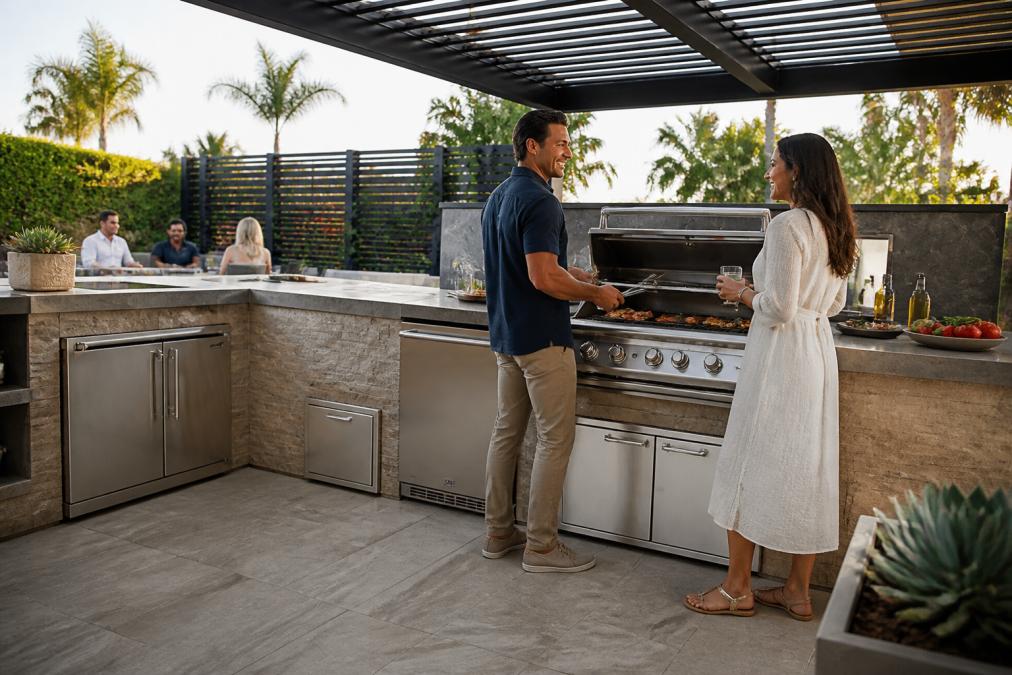
The layout follows the same work triangle logic as an indoor kitchen: grill, prep surface, and refrigeration should form an efficient triangle. Plan for infrastructure early. Retrofitting a gas line or 240V circuit after countertops are in place is costly and disruptive.
Materials That Hold Up Outdoors
Material selection determines whether outdoor kitchens hold up or fail over time:
- Stainless steel appliances and frames: Marine-grade (316) stainless resists coastal corrosion better than standard 304 grade.
- Natural stone countertops: Granite and quartzite perform well outdoors. Marble is more porous and requires more maintenance in wet climates.
- Porcelain pavers for flooring: Large-format porcelain pavers are non-porous, frost-resistant, and hold up to heavy use without staining or cracking. BellaFina Outdoors carries 24x36 2cm porcelain pavers and matching 13x24 2cm porcelain coping that work well around outdoor kitchen and pool areas.
- Concrete block or stucco frames: Durable and weather-resistant for the kitchen frame itself, though they require proper sealing.
- Powder-coated aluminum cabinetry: A strong alternative to polymer or wood cabinets in high-humidity or coastal environments.
Custom Backyard Fire Pit Installation and Fire Features
Custom backyard fire pit installation extends usable evening hours across every season. A fire feature gets spaces used more consistently than those without one.
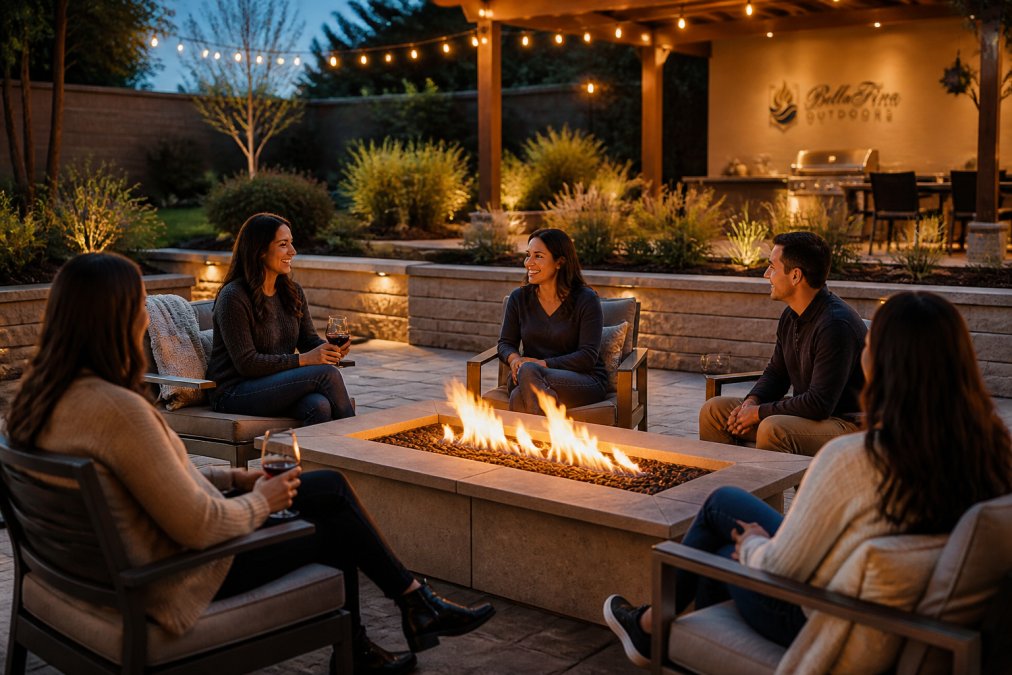
The first decision is fuel type. Wood-burning fire pits create the most authentic experience but require ash cleanup and are subject to local burn restrictions. Gas fire pits are cleaner, controllable, and compliant year-round. Natural gas is more economical for frequent use; propane offers flexibility where a gas line isn't available.
Options include in-ground fire pits integrated into hardscape, raised fire tables that double as surfaces, linear fire features for modern designs, and fire and water combinations that serve as focal points.
According to the California Air Resources Board guidance on residential wood burning, wood-burning fire pits are subject to Spare the Air restrictions during high-pollution periods. Gas fire features avoid this limitation entirely. Any gas fire feature requires a licensed plumber or gas contractor for the line connection.
Outdoor Heating Solutions for Patios Beyond the Fire Pit
Outdoor heating solutions extend the usable season on both ends. The fire pit handles the center of the space, but supplemental heating covers the perimeter.
Infrared heaters are the most efficient option for covered patios. They heat objects and people directly rather than warming the air, so they work even in breezy conditions. Electric infrared heaters can be ceiling-mounted and wired into a smart switch for easy control.
Patio heaters (freestanding): Propane tower heaters are portable and require no installation. They work well for temporary setups, though propane tank management is required.
Radiant heat panels: Flush-mounted ceiling panels that provide even, low-profile heat across a larger area. More expensive to install but nearly invisible and very effective under solid roof structures.
Outdoor Lighting Design Tips for Evening Entertaining
Outdoor lighting design determines safety, security, and how long people actually stay outside after dark. A well-lit outdoor space gets far more value than a beautiful space that feels dim after sunset.
Request a Design Consultation →
Layer your lighting across three levels:
- Ambient lighting: The base layer. String lights overhead, recessed lighting in a covered patio ceiling, or low-voltage landscape lighting. Sets the mood and provides general visibility.
- Task lighting: Focused light for functional areas. Under-counter LED strips in the outdoor kitchen, pendant lights over a dining table, or dedicated light over the grill. Critical for safe food preparation after dark.
- Accent lighting: Highlights architectural features, plants, water features, or hardscaping. Low-voltage path lights, uplights on specimen trees, or LED strip lighting along a retaining wall.
For outdoor kitchens and dining areas, warm white (2700K-3000K) LED fixtures create the most inviting atmosphere. Smart lighting controls allow you to program scenes and dim levels so the space transitions from bright and functional during dinner prep to soft and ambient during after-dinner conversation.
Hardscaping, Furniture, and Finishing Touches for Year Round Outdoor Living
Hardscaping is the backbone of any year round outdoor living space. Pavers, retaining walls, steps, and edging define zones, manage drainage, and set the visual tone.
Porcelain pavers have become a preferred choice because they're non-porous, highly stain-resistant, and available in large formats that reduce grout lines. They work well as pool coping, creating a consistent material palette from patio through pool edge. The Tile Council of North America installation guidelines for exterior porcelain provide useful technical reference for contractors.
Neutral palettes, warm grays, taupes, and sandy tones, age well and work with many furniture and plant colors. They also reflect less heat than darker materials.
Patio Furniture and Weather-Resistant Upholstery
Patio furniture that lasts comes down to frame material and fabric selection.
Frame materials ranked by durability:
- Powder-coated aluminum: Lightweight, rust-proof, and low maintenance. The standard choice for quality outdoor furniture.
- Teak: Naturally weather-resistant hardwood. Requires periodic oiling but lasts decades when cared for.
- Wrought iron: Heavy and durable, but requires rust-proofing.
- Resin wicker over aluminum: Good weather resistance when the underlying frame is aluminum.
For cushion fabrics, solution-dyed acrylic is the industry benchmark for outdoor upholstery. The color is embedded throughout the fiber, so it resists UV fade and mold significantly better than standard polyester. Avoid standard indoor upholstery fabrics outdoors.
Outdoor rugs define seating areas and add warmth to hardscape surfaces. Polypropylene construction resists mildew and cleans easily with a hose.
Smart Home Integration for Outdoor Spaces
A backyard designed for year-round use benefits significantly from automation: lighting scenes that shift with time of day, heating that activates on a schedule, and pool equipment that runs efficiently without manual intervention.
Practical integrations worth planning for:
- Lighting control: Smart switches or dedicated outdoor lighting controllers allow you to program scenes, set timers, and control zones from a phone or voice assistant. Plan conduit and wiring during construction.
- Pool automation: Systems like Jandy's iAqualink platform allow remote control of pool temperature, jets, lights, and filtration from a smartphone. A heated pool controlled remotely is a significant quality-of-life upgrade.
- Outdoor audio: In-ceiling or landscape speakers connected to a whole-home audio system extend the indoor entertainment experience outside. Zone control lets you run different audio in different areas.
- Security and cameras: Outdoor-rated cameras integrated with a smart home hub provide visibility and can trigger lighting when motion is detected.
The key planning principle: run conduit during the hardscape phase. Every smart device you might want to add later requires either conduit for wiring or wireless connectivity.
Sustainable and Eco-Friendly Material Choices
Sustainability in outdoor design involves material longevity, water management, and plant selection.
Material longevity is the most underrated sustainability factor. A porcelain paver that lasts 30 years with no maintenance has a lower environmental footprint than a composite product replaced every 10 years.
Permeable paving allows rainwater to infiltrate rather than run off into storm drains. Permeable pavers, decomposed granite, and gravel areas all reduce runoff. The State Water Resources Control Board stormwater management guidelines increasingly emphasize on-site infiltration for residential projects.
Native and drought-tolerant landscaping reduces water use significantly. Privacy screening using native shrubs and ornamental grasses requires less irrigation than traditional hedging and supports local pollinators.
Vertical gardening on fences or retaining walls adds greenery without consuming ground space, particularly valuable in smaller backyards.
Year-round outdoor living doesn't happen by accident. The spaces that actually get used across every season are the ones where someone thought carefully about shade, heat, light, materials, and how all those elements work together. If you're planning a backyard renovation and want to see how your ideas translate into a real design before construction begins, the BellaFina Outdoors team offers design and visualization services that walk you through the full project. Visit the Huntington Beach design center to explore products, discuss your project, and request a design consultation.
Frequently Asked Questions
How can I make my patio comfortable in the winter?
Coastal Southern California winters are mild, but evenings still drop enough to chase people inside. The most effective combination is an overhead structure, a covered patio or pergola, paired with a gas fire feature and infrared patio heaters. Adding weather-resistant curtains or privacy screens on the windward side cuts the chill significantly. With those three elements in place, most patios stay comfortable from October through March without major changes to furniture or layout.
What are the best fire features for coastal climates?
Salt air and moisture accelerate corrosion, so material selection matters more near the coast than inland. Look for fire pits and fireplaces built with powder-coated or marine-grade stainless steel burners, GFRC (glass fiber reinforced concrete) surrounds, and sealed natural stone or porcelain finishes. Gas-fueled fire features are generally easier to maintain in coastal conditions than wood-burning ones. The Outdoor Plus fire and water features are designed with these conditions in mind and are worth exploring for coastal installations.
How do I design an outdoor kitchen for year-round use?
A weatherproof outdoor kitchen design starts with a covered structure to protect appliances from direct sun, rain, and marine layer moisture. Choose cabinetry rated for outdoor exposure, stainless steel, marine-grade polymer, or sealed concrete, and specify appliances with weather-resistant ratings. Porcelain countertops and pavers handle temperature swings and moisture better than most natural stones. Plan your gas and electrical rough-ins before any hardscaping is poured, and confirm local permit requirements early to avoid costly changes mid-project.
What lighting solutions work best for evening outdoor entertaining?
Layer three types of light for the most functional and visually appealing result: ambient lighting from string lights or soffit-mounted fixtures, task lighting over cooking and dining areas, and accent lighting to highlight landscaping, water features, or architectural details. Low-voltage LED systems are the most practical choice for outdoor use, they run cooler, last longer, and can be connected to smart home controls for scheduling and dimming. Warm white tones (2700K-3000K) create the most inviting atmosphere for entertaining.
This article was written using GrandRanker